Showing posts with label I was told there would be no math. Show all posts

Sunday, September 2, 2012

On Gamification

So I'm looking at the trusty calendar of blog posts around here, and it seems it's been about five months since I personally have written anything. To be fair, I've had something to write about for a couple months now, not including the Axis and Allies Global contests where the Axis actually won. You'd think that would be something that should have come up, especially since I was the one who pulled it (actually it was twice) off, but I'm lazy. And as it turns out, the topic I am going to write about isn't the one that's getting written about. Suckers!

...no, you shut up.

Wednesday, April 11, 2012

Killing Zombies for Fun and Profit

Time for an update on the Zombie Game. If you'll recall, last time we discussed it the game was undergoing some serious rules revision. After a couple playtests, it's clear that there need to be some even more serious revisions before we get anywhere with it. Quick recaps: the first game featured a surprise attack by the United States on the Arab League. I know, shocking, right? The game went poorly, due in large part to the fact that we didn't have a decent board at that point. So, a couple weeks later, we tried again. Inspired by the previous surprise attack, I, as the Arab League, launched a surprise attack on Russia, for the same reasoning as previous: their lands were wide open. The counterattacks were not unexpected, but the nuking was. The zombies won soon after that.

So, in the third game, we decided to see what would happen if all sides went after zombies exclusively. Short answer: they'd win, but it takes too long for it to happen. After about seven or eight hours of playtime we eradicated most major concentrations of zombies with several sets of minor outbreaks on the board.

Instead of doing the full recap here, I'm just going to outline some positives and negatives I happened to notice.

Positives:
1. Killing zombies is still really fun.
2. The special abilities the nations have are also a lot of fun.
3. This game is going to be the only time I ever get to say "man, suicide bombers are totally awesome."
4. Making fun of the UN never goes out of style.
5. Rolling 30+ dice at once and still needing to roll more? Also good.

Negatives:
1. Hard to kill zombies fast enough.
2. In a regular game, the zombies are probably going to win.
3. Lack of rulebook meant that half the time we weren't sure how to rule on something.
4. After a while, rolling more than 30 dice can get kind of annoying.
5. Right now, the only way to wipe out all the zombies is with nukes. I'm not opposed to this, but I dislike it being the only option.
6. The event cards are, in general, too uniformly negative, which in a zombie world, might be to be expected. Even so, I think it needs a change.

I think that's about all I've got right now, I might discuss specific changes later now that I've got these going on.

Friday, September 16, 2011

Replays and Replayability

(No, this isn't going to be a what-if featuring Jane Austen playing D&D. -ed) (Hey, that's not a bad idea! -B) (No! -ed) (C'mon! -B) (Dammit, I said no! -ed)

Warning: This post will contain links to game wikis. If you are worried about spoilers, I suggest not following those links through.

So yeah, this issue's been bugging me for a while, and if I can't get a suitable discussion out of it, I can at least get some content in here. First of all, what makes a game re-playable? Using some of our standard examples, in Kingdom of Loathing, once you beat the final boss, you are given the option to ascend and start at level 1, keeping one or more skills from your previous run, and doing the new run in a variety of different ways. In Fallout: New Vegas, and the other Fallout games to varying extents, you can play through using different skills and/or make different choices, leading to other endings. Another option used in New Vegas is that of achievements, giving you some sort of boost to your fragile ego by giving you awards for things that you either might normally not do, or for doing a lot of the things you would usually do. If you have a couple spare hours, you might ask Zerg_Rush how he got the title "The Insane" for one of his WoW characters. I'm sure you've run across these tactics to squeeze more playtime from other games, I'm just using the examples I've run most recently. Some, of course, are more effective than others.

The more philosophical question is what actually causes one to replay a game? Havoc Jack just spent at least one post talking about how he's restarted Diablo II, but I can't normally seem to muster up that much desire to replay a lot of games, especially after I just finished it, whereas I've seen him finish a Starcraft I campaign and immediately start replaying the same campaign. Every once in a while, I will go back into the vaults and work up some game I haven't played in a while, but for the most part I don't replay games that much. Starcraft II was pretty awesome, but after playing it once I haven't really gone back to it at all, except for running a few missions trying to get achievements. I haven't actually finished Fallout: New Vegas yet, but I don't really plan on playing through again once all the DLC comes out and I actually do finish the game. I ran though Fallout 3 twice, although that was primarily because I got DLC for that and decided it would be simpler to play through again. On the other hand I play KoL all the time, and am constantly ascending. Perhaps it's just that easier accessibility to a wiki and easier character optimization makes me want to play it more, although according to Steam I have played New Vegas for 62 hours, so I guess that's a decent amount of time spent on it. And of course, I did end up reading a lot of the wiki, and sometimes I find that reduces my desire to actually play the game.

I'm not sure why this single-play tendency only applies to video games, though. I've played any number of board games any number of times, I've watched many movies as much as I could stand, and nearly all the books on my bookshelf have been read dozens of times.

Insofar as no one else can answer the question for me, perhaps if anyone actually reads this blog instead of it being a vanity project for us they can attempt to answer the question for themselves.

Tuesday, August 9, 2011

MMO Arbitrage

So today I'm going to talk about an idea I had back in the day, possibly even while still in high school. As the title says, it's MMO arbitrage. I'll assume here that anyone reading this blog knows what an MMO (or MMORPG if you want the full acronym) is, but arbitrage may not be, so if you're too lazy to click that link, it's the process of making profits by trading something (usually currencies) at different rates. How does this work? Let's say I can buy euros with dollars at a 1:1 ratio in Lisbon. I can then sell the euros for $2 in Prague, then return to Lisbon and purchase twice as many euros, and repeat the cycle. The really good arbitrage is going to go through three or four currencies along the way and won't make near as much money per unit. (Ideally you'd also cash out with dollars and head to the States to spend them up, or find another arbitrage cycle to play with)

Anyway, how does this relate to games you may ask? Again, I'm assuming you did, because that's the question that's about to get answered. My plan was to create a stable of characters in several different MMOs, each of which had a certain amount of ingame cash. (The amount? Large) This would allow players who'd accumulated a large amount of cash in one game to trade it for cash in another game, so they could enjoy the wealth they had accumulated. Of course, most people could see several problems with this, such as:

1. Wouldn't it take a lot of time to accumulate that much wealth on that many games? Yes, it would. Unless of course I were able to recruit already rich players or buy them off. I suppose buying resources would be reasonable, given that most businesses expect to start off with a certain amount of investment.

2. How would you determine the cash value of the ingame currencies? The only one I can give a good accounting for is Kingdom of Loathing. As has been previously discussed, the game's currency is Meat, and there's no subscription fee. You can however donate $10 and receive a Mr. Accessory, which in addition to being pretty useful its own dang self can be traded in for monthly Items which do even more nifty things, and more importantly be sold to other players, making for a decent currency conversion. Currently they're selling for 8 million meat, making the conversion roughly 800,000 meat/dollar. So there's one.

3. How would you make money? Besides taking a commission on trading currency from one game to another, there would presumably be personal arbitrage trading and other deals going on the side, assuming the time and wherewithal to do so.

4. What would cause people to trust you? If my word of honor isn't enough, I shall demand satisfaction! Really, though, there's not much of a way, although I'm not familiar enough with PayPal to be sure that there's not a way to enforce a deal if it goes south.

5. How would you know what games to work with to actually get profits? Again, I've no real idea. My guess would be it would require one character in pretty much all MMOs that had a decent fanbase.

6. What about games that don't allow reselling of currency or items via third-party vendors? What about them? This is probably the biggest hurdle, but not the one that actually stopped me. (It was laziness more than anything) If I thought I could actually make a decent profit off this thing, I'd be willing to see if I could work around this. Unfortunately, I think it's just a decent idea. Still worth blathering about though.

Sunday, July 31, 2011

Assemble one Economy

Now that we have our solar system more or less laid out, let's continue looking into the economy. Broadly speaking, the economy exists to transform time into spaceships with which to blast the enemy. Consequently, in broad strokes let's try and figure out what goes into spaceships.

There are only a few really vital characteristics to a warship. From my previous post, the interesting ones are:


How hard it hits
How many hits it can take
How accurately it fires
How fast it can move
How much it can carry

The question here is, how do you achieve those characteristics, and what materials do you need so to do?

How hard it hits:
Nuclear weapons. Your standard atom bomb has a hollow sphere of plutonium in the middle, surrounded by a soccer ball array of high explosives, which have some complicated electronic triggering mechanism. Then you stick it in a steel shell so it doesn't fall apart, and a rocket engine on the back to get it where you want it to go. (the bomb detonates by blowing the high explosives to crush the plutonium into a very small nugget, which then hits critical mass. It's bombarded by neutrons, and all hell breaks loose.)
So, in a materials checklist we have: Plutonium, High Explosives, Advanced Electronics, Steel, and a Rocket Engine.

What's in a rocket engine? Let's skip down to

How fast it can move

I'm thinking of these ships moving due to advanced fusion motors. What makes them advanced? My say so. Also, if you install a Langston Field into a heat engine you can get some interesting properties. If you stop over once again at the incontestably useful Project Rho, you learn that one of the main factors that affects the feasibility of engines is not letting your engine melt due to waste heat. If we run our fusion reactions inside an inverted Langston field, the energy from the reaction is absorbed and emitted only inwards; we can sustain all kinds of scary high energy reactions without damaging our ship or crew. Just leave a hole open in the back so that you can go rocketing along. (I haven't run the numbers proper just yet, but I expect I'll work off of this type of engine)

Anyways, an engine includes Fuel, Reaction Mass and a Langston Field generator. Since I mentioned the ability for spaceships to generate their own hydrogen supplies (again with that field. You see why I try to keep my miracle devices to a minimum?), I think we'll qualify both fuel and reaction mass as Hydrogen, allowing us to move on to

How many hits it can take

Which is entirely dependent on the properties of a Langston Field generator. So I guess I've got to 'fess up to what's actually in these things. You ready?

Exotic Materials.

No, I don't have any idea how one of those things ought to work either. Moving along;

How accurately it fires

Since we're pretty much entirely talking about missiles, we're asking what a missile needs to connect with it's target. It needs to find a potential target, identify as friend or foe, measure relative positions, velocities and accelerations and modify it's own vectors to collide with said target. It also needs something to tell it precisely when to detonate.

All that I'm going to sum up in my previous category of Advanced Electronics. Convenient. One last warship category:

How much it can carry

Seeing as cargo space is mostly empty volume, we can ignore this category. Or, in a move that saves me some rewriting on this post, we can talk about what the ship needs to carry some of it's more vital components; people.

People require some basic things to live. Food, water, air, access to the internet. At least those first three. In the context of our discussion, our spaceships have to be able to carry a basic livable habitat for the people. In resource terms, I'm going to shoehorn all of that into Organics; I'm looking to build game pieces not actual starships. Note though, that a troop transport ship will require a whole lot more life support than an ore freighter.

There are also considerations involving the ship itself; you need a steel framework to hold the various pieces together (you could go with titanium or some such, but with the Langston field providing the defense, you really only need enough structure to hold the thing together. Steel is still cheapest.) You need some vast, complicated bridge with a huge glass window and oddly shaped chairs and large computer banks with blinking lights on them. There are other features that are useful for maintenance, Medbays, Machine shops, the sergeant's illicit still, that sort of stuff. But broadly speaking, they fall under the same resource categories. To sum up:
Organics, Steel, Advanced Electronics

Let's list out those resource types for all the categories:
Plutonium
High Explosives
Advanced Electronics
Steel
Hydrogen
Exotic Materials
Organics

Seven types of resource. Can we pare that list down at all? Sure. For starters, let's just pretend the High Explosives don't exist. (Side note: this is not a winning legal defense.) Furthermore, Plutonium is only a component on the bomb side of things. If we upgrade to H-bombs, we still need a plutonium detonation to trigger the hydrogen explosion. I suppose I could just say "Future!" and hand wave that away. I think I'd rather shoehorn it into the Exotics category. One more; Hydrogen, while it's useful to remember it's there, can be safely ignored. That brings us down to four categories:

Electronics
Metals
Organics
Exotics

I'm going to add in one more category:

Labor

Or possibly Money. I'm less certain about this one than the others. While I don't want to get into all the details of financing (buy war bonds!) I want to provide a resource that can be expended to ease tension between other resource amounts. So, if you don't have enough Electronics one week you can expend a certain amount of Metals and Labor to turn it into Electronics. Or if you need more steel, you can expend labor to boost it up wholesale from Earth's gravity well. (Remember, the cheapest way to get steel in space is to start with steel that's already up there; thus the asteroid mining and so forth. You can stick some on a Saturn V rocket and send it up to the orbital factories, but that'll cost you.)

It also allows us to gather resources from locations that wouldn't have them normally, or produce the wrong type. There's a small settlement on Mars; not large enough to pull things out of the gravity well. So what good is it? It produces Labor.

As with most things at this stage of the game, these resources aren't set in stone. Except for the metals, which are probably an ore in some obscure asteroid right now. Next time I get back to this topic We'll go over a map of the solar system and discuss what gets produced where, and how much.

Friday, July 8, 2011

How to Min/Max Your Nation

I finally finished my first playthrough of Europa Universalis III. According to Steam, it took 329 hours, although having left it open overnight a couple times probably assisted in that total. Anyway, I of course have some things to say about the game. I'd organize them in some fashion, but I really don't want to. So you've been warned.

EUIII is a nation simulator which happens to take place between the years 1399-1821. You take the part of the leader of a nation, and I mean any nation. You have your various European duchies, counties, prince-bishoprics and the like, some of which you can attempt to build into the nations we have now, you have the various hordes of the Central Asian steppes, you have your various Eastern empires, and last, and possibly least, you can also choose to be several Native American tribes or one of the nations of mysterious Africa. So having loaded it up and checked out a couple of these tribes after the first play (I chose Novgorod, somehow never got around to turning it into Russia) it seems that they've weighted it against being able to have African tribal musketeers waiting for the conquistadores. Which is somewhat strange, given that it's not entirely given over to historical accuracy, but I suppose makes a certain amount of sense.

So let's talk about historical accuracy for a bit. They try to work in a certain amount of accuracy, such as their tech research. Putting a lot of cash into any one branch of research (gov't, production, trade, naval, or land) will result in getting to higher levels faster, however at a certain point it will make those higher levels more expensive to ensure you don't reach them too soon. In addition, the larger the empire you have, the more the tech is supposed to cost; even so with the largest empire I had the highest levels in government and land research. I suspect this is an inadvertent offshoot of having picked a Russian country myself. It probably also had something to do with the sliders, but I can't speak to that for certain, because I haven't gone through the manual.

Speaking of which, the PDF version weighs in at 148 pages, truly an example of tl;dr if ever there was one. I mainly used it as a reference guide when I remembered it was there to reference. One of the things I found in there that I did like was their position on doing things that they knew weren't technically or historically correct in order to make the gameplay better, a position that we here at Awesome Games wholeheartedly support. And make use of, more often than not. I do believe it helps to actually know said history, and I'm pretty certain these guys do.

Moving on, I'm going to talk about the post title for a bit. This game is really all about the min max. You have sliders that represent more or less every policy you can have, sliders that represent your budget, numbers that represent your relationships with other countries, and probably many more that I don't want to look for right now. It's not hard to go into information overload, or on the opposite end start making spreadsheets and databases to play this game. On the other hand, at certain points I could use a bit more information, usually when I'm attempting to form an alliance or secure trade rights. When you go to do diplomacy, you'll get a blurb that gives the likelihood of any of your diplomatic requests succeeding, from Very Likely to Impossible. What I want to know is why I get said rating, and how can I change it? When I offer an alliance to a nation in the same region as me, with the same religion, with whom I have max positive relation, I'd think they'd be amenable to it, but no. Is it my alliance with someone else, government style, what? (Sidenote: You have several different governmental styles available, dependent of course on your government tech level. I probably should have switched at some point, but the Merchant Republic I started with allowed me to form Trade Leagues. I'm not sure what, if anything, those did for me, but I really liked the idea and thus stayed with it.)

So of course, what else am I left to do but go to war with them. As much as I hate to admit it, this game makes you think before you go to war, which is generally a good thing. Failing that, it makes you need to set it up so you can constantly be at war without taking too many penalties. I was usually pretty good at that. Some of the things EUIII makes you consider before you go to war are: your stability score, which is more or less how happy your nation is, and will go down precipitously if you go to war with no reason, or against a nation with which you have good relations; who the nation is allied with, if anyone, your Casus Belli, assuming you have one (you don't need one, but it helps) and of course, the military strength of the nation. (that one's not in there, but you need to do it anyway) Which reminds me, in one of the many charts available in game, you can find that out. About any nation, not just the ones you know about, which seems somewhat strange to me. They have fog of war, but you still know how many troops are out there?

Assuming you win, you have to be careful here, too, as you generally can't just annex the nation into your empire. Again, there's a dizzying array of options available, but it generally comes down to Infamy, which if raised above a certain level will basically give every nation a free swing at you. This is generally raised fastest by annexing nations or taking big chunks of their territory, except for certain cases such as border disputes. It goes back down over time, but usually not fast enough to suit me.

At any rate, I figure I must be getting close to how much I can type here, plus I think that this is enough for now. If you enjoy moving sliders and filling bars while engaging in diplomacy and fighting wars, you'll probably enjoy EUIII. If not, don't say I didn't warn you.

Tuesday, January 4, 2011

Min maxing and fractal mechanics

Some people are crazy.

Ok, lots of people are crazy. All of us, in fact. But this is a particular kind of crazy I want to talk about. The min-maxers. The munchkins, the optimizers and power gamers who will spend hours poring over sourcebooks trying to find half a percentage more dodge rating. The kind of person who will spend literally forty minutes taking a turn just so they're sure they've eked out every last scrape of advantage. Randy. Err... someone who's name I've certainly changed to not reflect on the guilty parties. Let me start over.

Last night I spent a couple hours playing Torchlight for the first time. Yeah, I know it's been out for a while, but I just don't play new video games nearly as much anymore. Torchlight is mostly a repackaging of Diablo II. Close enough that, after spending years playing D2 in high school, I was preemptively sick of torchlight. Even so, I was reluctant to put the game down when it came well past time to go to bed. So naturally I fell asleep reflecting on what made Diablo II a good game to begin with. In my mind, one of the most significant factors is the character creation process, together with the vast range of potential equipment. (Even if you do go for the Burrito Dough Cannon every time.) Which brings me to my topic:

What if I design a game that offers min-maxers unparalleled opportunities to manipulate the rules to maximize their character?

Now check your mouth. For most of you, the bile is rising in the back of your throat. That's good news. It means you're (relatively) normal, and that you should hit your "back" button and flee for your life. This way madness lies. If, on the other hand, you're unconsciously salivating, well, this is the place for you.

So what would be the characteristics of such a game? Well, it'd necessarily be single player. Waiting for five other players to take long, complicated actions and then explain them to everyone else sounds perfectly miserable to me. Maybe two player, if you can convince them to do their setup elsewhere, on their own time.

The main thing is, the rules have to be incredibly complicated. Or at least they have to have incredibly complicated implications. Just having the rules pointlessly complicated is frustrating and boring. So Fizzbin wouldn't qualify. No, we want rules that allow for any amount of complexity you're willing to endure, and most importantly we need a buzzword to describe it:

Fractal mechanics

Fractals are... you know what? Let the power of song explain it, if you don't already know. Here; build your own. Draw a triangle. Then make it into a triforce by drawing an upside down triangle in the middle. Continue by drawing upside down triangles in the rightside up triangles until you can't draw anymore; they're too small. You've made a Sierpinski sieve. The point is, it only requires a simple procedure to make, and yet you can make it as complicated as you want. Neat, huh?

So how would you make fractal mechanics? Well, let's define fractal mechanics to have three basic properties:

The main principle of the rules is easy to grasp; like the way you draw the sieve.
The majority of the benefit gained from the mechanic has to be in the first one or two iterations
The more effort you're willing to put into maximizing the mechanic, the more benefit you'll get out of it.

Let's talk about this in the context of a fantasy RPG. In most of these games (I can't think of a counterexample, but one might exist) the relationship between your character's strength and the damage he does swinging his sword is linear. That is, you add +10 strength you get +20 attack power (WoW), or going from ST 10 to ST 12 increases your basic thrust by the same amount that going from ST 12 to ST 14 would (GURPS). Let's say we change that.

If your sword damage went up proportional to the Square Root of your strength, you get some interesting results. Larding on more strength will always increase your damage, regardless. But the more strength you add the less and less it benefits you. Now, if we also allow that the game has items that either increase or decrease your strength, you have the option of using those. The more strength you have, the less the penalty of decreasing it somewhat, particularly if the item has better bonuses to compensate for the normally large minus.

That's three levels of complexity (+str is always good-> +str gets worse and worse -> items that reduce str aren't always as bad as they seem). The fourth level is much more difficult. Suppose you start with a low strength, and use items to push it in the negatives. What happens? Most games would just redefine that as zero strength to make the math easier, but suppose we don't. If you take the square root of a negative number, you get an imaginary amount of damage. What's that mean? Anything we want it to. Let's say it works like elemental damage in normal games; I can attack for 200 damage +50 fire damage. Instead I'm attacking for 100 real damage and 40 imaginary damage. As long as imaginary damage takes away real hit points, we're still in business.

That's a fourth level of complexity; modulating into imaginary damage for whatever benefits that provides you.

So there you go, a fractal mechanic. Four isn't infinity, but it's close. Is it possible to do better? I'm sure it is, I'm coming up with an example on the fly here. Let's broaden our horizons a bit, to see what that'd accomplish.

Imagine a game where every single one of your stats worked like that; a simple relationship that encompassed hidden depths of complexity. Imagine that every item and modifier you got changes one or more of your stats, or offers other benefits. Imagine doing all that arithmetic by hand. Yeah, I'm thinking this will necessarily have to be a computer game of one sort or another just so you don't have to work things out yourself.

It's an interesting idea. It's only marketable to a certain type of hardcore gamer, and games that require you to be hardcore don't generate fans easily, so I don't see making this as a for profit venture. Maybe as a project, after the Terrible Secret of Space winds up. Actually, I'd better get back to that.

Monday, October 25, 2010

Battling, in Space!

You know, I think it's going to be a while before I get tired of the word "Space!". I'm fine with that. Anyhow.

As far as I can tell, there are five basic qualities one has to be concerned about for your warship of space: (or Space! even)

How hard it hits
How many hits it can take
How accurately it fires
How fast it can move
How much it can carry

Pretty much any spaceship can be described with those variables. A dreadnought hits hard and takes a lot of hits but it moves very slowly. A transport also moves slowly, but it doesn't hit hard and carries a lot. A fighter moves quickly, but it doesn't hit very hard and I wouldn't bother insuring it.

Now, we need actual numbers to answer those questions, but those are hard to provide. I can't tell you how hard something hits without being able to make statements about how many hits ships take. I can't tell you how fast it can move without going over how much it can carry, and whether it's empty or full. And I can't make any statements about any of that without answering all kinds of questions about the underlying technology; what kinds of engines the ships use, how much reaction mass they're toting around, how large you can make a Langston field, how many crew are necessary to run a ship and how effective is the life support, that sort of stuff.

Well, I'm going to start answering some questions, if only in a generic, background sort of way. To start with, how do the ships move in space? Last time I spoke about this, I was talking of interplanetary travel, not the short bursts of hard acceleration that are preferable in combat.

The first thing to understand about movement in space is that there's no air resistance. There's no friction, and nothing that will slow you down. As long as you keep your rocket firing, you'll keep accelerating, at least until you hit relativistic concerns. The most important implication is that you have no polite way to stop, other than by shoving even more reaction mass forward. You accelerate halfway there, you decelerate halfway back. Ok, we covered that already, at least for interplanetary trips.

On the other hand, if you're in mid combat, well, that isn't going to cut it. You want to be able to move any which way at a moment's notice. So you need a way to keep track of how you've been moving. Enter the vectors.

What's a vector? It's the word they use for something that carries a disease. In a definition more germane to the task at hand, mathematically it's any quantity that has a direction and a size. Velocity and acceleration comprise our vectors of choice. Here I'm going to be borrowing heavily from the board game Triplanetary. From the inestimably valuable Project Rho we get a description of the movement rules, which are really the most interesting part of the game.

Basically, you preserve whatever motion you had last turn, and you can add on one space of acceleration in any direction to change that vector. Suppose you're going left at two hexes a turn. If you want to speed up you can accelerate in the direction you're moving and next turn you'll be coasting along at three hexes a turn. Or if you want to stop you can accelerate directly opposite the direction you're moving and you'll be going one hex a turn next turn, and can stop further from there. Or if you want to curve, well, you can modify your movement vector that way.

The real fascinating bit, and the part that got me to shell out for my own copy of the game, is how the game handles orbits: as a natural consequence of the simple rules the game allows you to park your ships spinning around a planet with no expenditure of fuel. Exactly like real life. If you want the details, I highly suggest you click over to Project Rho and read about it yourself--I'm not going to recap it here.

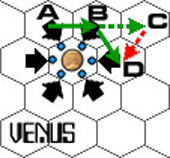
The only trouble is that you're stuck with a fixed number of gravity hexes. Imagine you wanted to draw a gravity arrow mid hex C. It'd point directly at the planet, but unfortunately not directly at another hex. You'd screw up your movement going through there as you wouldn't land in the middle of another hex. So if I want to make other, interesting battlefields I can't use the system as is. Especially since I want ships to accelerate at different speeds. You can't move in fractional hexes, so you'd have to have your faster ships move more hexes, which diminishes the value of a block of six gravity hexes; it's too easy to go around.

If I was laying the battle out on a physical board then I doubt I could come up with a better system than Triplanetary runs. On the other hand, why am I constraining myself to a physical board? I'm not going to make it into a video game, but there are advantages to going part way. Let's say we keep time discrete, measured in units of turns, but make space continuous. (As a side note, most video games don't even go there. They make time and space both discrete, or both continuous). What does that do for us?

To start with, it neatly solves the problem of fractional hexes, by allowing fractional hexes. This in turn allows much more flexibility in constructing gravity fields for the ships to fight in. Imagine, for example, a large and long rectangle, with Mars forming the lower right corner. The closer your spaceships get to Mars, the larger effect gravity has on their movements. On the other side of the board though, there isn't much effect at all. But since we're letting the computer worry about it we can still factor it into the result. It also allows fractional movement. Different ships can have different accelerations and still be neatly included on the board without having to worry about it.

The computer also allows us to dynamically track distances and odds. If I'm accelerating this way and I'm at that speed already, how likely am I to hit that guy doing similar things in other directions? If I were figuring this in Gary Gygax's basement forty years ago (has it really been that long?) I'd have to include formula and tables and whatnot, but again, we can let the computer worry about all that. We can even, at little extra cost of expenditure, figure out things like glancing blows (if a nuke detonates at this radius from a ship, how much energy is imparted to their shield?) and the effects of exploding ships on others in their radius. Wonderful stuff, really. I don't have the calculations mapped out yet, but I don't forsee them being too terrible. Or the programming, but that's another issue.

Thursday, September 23, 2010

When 2+2 doesn't equal 4

A friend of mine recently told me that I post too much math to this blog. Well, today I get to disappoint him. Don't worry, the math isn't hard at all.

We're going to be discussing the cases where 2+2 doesn't necessarily equal four.

Now, before you ask, I'm firmly seated on my rocker, in possession of a full set of marbles and deck of cards, and my lid remains unflipped. Let me get an example for you, so you may be as persuaded of these facts as I am. Well, I shouldn't expect that sort of miracle.

In Magic: the Gathering you win by reducing your opponent's lifetotal from 20 to 0. (A quick side note for the quibblers. Yes, there are alternate win conditions. Yes, there will be exceptions to other things I say about the game. Ignoring the complications for now to keep it simple.) You reduce their life total by attacking them with creatures. So it'd take twenty turns to kill someone with a one power creature, and ten with a two power creature, assuming they don't do anything that stops you. In fact, let me make a table of that for you:

1 power: 20 turns
2 power: 10 turns
3 power: 7 turns
4 power: 5 turns
5 power: 4 turns
6 power: 4 turns
7 power: 3 turns
8 power: 3 turns
9 power: 3 turns

Contrary to my previous assertion, we see that it takes exactly two bears to win the game in the same time as one Serra Angel. But look at three power, if you work out the ratio it takes 40% more hill giants to kill in the same time span a Serra Angel could, when 4 is only 25% larger than three. How does that work? Even worse, take a look at the six power guys. Despite being slightly better than a five power guy, they still kill your opponent in the same amount of time. Same thing with seven, eight and nine power, it's all three turns.

This works, not because in some situations three is actually smaller than others, but because three doesn't divide evenly into 20. You only need to deal 20 damage, there's no bonus for going over. Since doing three damage a shot doesn't stop until you hit 21, that last point of damage is wasted. Attacking for five gets to twenty exactly in four turns, but attacking for six gets to twenty four, with surplus pain. Relatively speaking, five is just as good as six despite the fact that our starting postulates make six objectively better.

(The example is pretty obviously not that relevant in a game, but I have noticed that sort of thing come up playing an aggro deck against control. Looking at a 6/6, counting the turns I had to draw a lightning bolt to finish him off and realizing that it was still four.)

So where else does this apply? Well, I can't think of another game off hand, but it is the mechanism that allows computer worms to work. Y'know, like the one in Office Space? Or that old Superman movie they referenced in Office Space? Anyway, the programs treat dollars as if they're continuous, which means that when they divide them they sometimes get fractional pennies that can't be expressed in real world money. So they round them off, because who cares about a fraction of a penny anyway? All it took from there was someone to notice that money was disappearing and figure out a way to make that money his.

Another way this sort of thing happens is when you're talking about relative power levels. Again with the magic example. Let's say that on my side of the board I've got three glory seekers (a 2/2 with no abilities.) On your side of the board you've got one Stone Golem (a 4/4). If I try to attack with my glory seekers, one is going to get beaten by the angel and then I'll have traded a creature for a lousy couple damage-- not a very good exchange. So I've got to sit back and wait until you decide to do something, which means that your one 4 power guy is superior to my three two power guys, despite the math saying something different. (Of course, all this can be changed by either of us having any one of a number of combat tricks, but we're doing the default right now.)

More generally, we can look at a set and try to figure out what the relevant toughness is. Take Magic 2011, the most recent core set. My brother did the analysis, by the time he was drafting his first packs he already knew to stay away from two toughness cards like glory seeker. Why? There's an abundance of creatures that can profitably hold off an army of glory seekers in the set. Like that Stone Golem. Or a Giant Spider. Or an Azure Drake. Or any number of commons. That and Pyroclasm, as a kill spell that hits multiple creatures of two toughness, could really wreck his day. A single 3/3, by virtue of that one more point of power, can fight it's way through quite a few more combat situations than a 2/2. Leading me to make such inane but accurate statements like "Three is SO much more than two!"

Ok, another example. Let's talk hearts. (If you don't know hearts, your windows computer has it as one of it's built in games. Learn how, it's a good game.) Ok, say that I'm playing in a four player game, and it's my lead. Hearts has just been broken, and I want to get rid of the lead, so I want to lead a low heart. I have the 5 and the 9. How likely am I to take the trick if I lead one versus the other?

Let's say that I lead with the five. There are exactly three cards that get under it (the 2, 3 and 4). If I lead the Nine, there are three more cards (6, 7 and 8; we know where the five is already.) The problem is is that taking it with the nine isn't twice as likely, it's several times as likely. I'd give you the actual numbers but I royally confused myself trying to remember how to do a simple calculation and so you're going to have to suffer through inexact figures.

But think of it this way. I lead the five, West has to have one of the three, North has to have one of the two remaining and East has to have the last one. It's not that likely. If I lead with the nine, even if the other two have cards East has any of four possibilities to duck under. Or each of them might have two. The only way the nine doesn't take it is if some sad sack has missed six chances to get one of those cards in his quarter of the deck. Those aren't very good odds. In this way we see that the Nine is more than twice as dangerous as the five, even against the logic of our first intuition.