Now that we have our solar system more or less laid out, let's continue looking into the economy. Broadly speaking, the economy exists to transform time into spaceships with which to blast the enemy. Consequently, in broad strokes let's try and figure out what goes into spaceships.
There are only a few really vital characteristics to a warship. From my previous post, the interesting ones are:
How hard it hits
How many hits it can take
How accurately it fires
How fast it can move
How much it can carry
The question here is, how do you achieve those characteristics, and what materials do you need so to do?
How hard it hits:
Nuclear weapons. Your standard atom bomb has a hollow sphere of plutonium in the middle, surrounded by a soccer ball array of high explosives, which have some complicated electronic triggering mechanism. Then you stick it in a steel shell so it doesn't fall apart, and a rocket engine on the back to get it where you want it to go. (the bomb detonates by blowing the high explosives to crush the plutonium into a very small nugget, which then hits critical mass. It's bombarded by neutrons, and all hell breaks loose.)
So, in a materials checklist we have: Plutonium, High Explosives, Advanced Electronics, Steel, and a Rocket Engine.
What's in a rocket engine? Let's skip down to
How fast it can move
I'm thinking of these ships moving due to advanced fusion motors. What makes them advanced? My say so. Also, if you install a Langston Field into a heat engine you can get some interesting properties. If you stop over once again at the incontestably useful Project Rho, you learn that one of the main factors that affects the feasibility of engines is not letting your engine melt due to waste heat. If we run our fusion reactions inside an inverted Langston field, the energy from the reaction is absorbed and emitted only inwards; we can sustain all kinds of scary high energy reactions without damaging our ship or crew. Just leave a hole open in the back so that you can go rocketing along. (I haven't run the numbers proper just yet, but I expect I'll work off of this type of engine)
Anyways, an engine includes Fuel, Reaction Mass and a Langston Field generator. Since I mentioned the ability for spaceships to generate their own hydrogen supplies (again with that field. You see why I try to keep my miracle devices to a minimum?), I think we'll qualify both fuel and reaction mass as Hydrogen, allowing us to move on to
How many hits it can take
Which is entirely dependent on the properties of a Langston Field generator. So I guess I've got to 'fess up to what's actually in these things. You ready?
Exotic Materials.
No, I don't have any idea how one of those things ought to work either. Moving along;
How accurately it fires
Since we're pretty much entirely talking about missiles, we're asking what a missile needs to connect with it's target. It needs to find a potential target, identify as friend or foe, measure relative positions, velocities and accelerations and modify it's own vectors to collide with said target. It also needs something to tell it precisely when to detonate.
All that I'm going to sum up in my previous category of Advanced Electronics. Convenient. One last warship category:
How much it can carry
Seeing as cargo space is mostly empty volume, we can ignore this category. Or, in a move that saves me some rewriting on this post, we can talk about what the ship needs to carry some of it's more vital components; people.
People require some basic things to live. Food, water, air, access to the internet. At least those first three. In the context of our discussion, our spaceships have to be able to carry a basic livable habitat for the people. In resource terms, I'm going to shoehorn all of that into Organics; I'm looking to build game pieces not actual starships. Note though, that a troop transport ship will require a whole lot more life support than an ore freighter.
There are also considerations involving the ship itself; you need a steel framework to hold the various pieces together (you could go with titanium or some such, but with the Langston field providing the defense, you really only need enough structure to hold the thing together. Steel is still cheapest.) You need some vast, complicated bridge with a huge glass window and oddly shaped chairs and large computer banks with blinking lights on them. There are other features that are useful for maintenance, Medbays, Machine shops, the sergeant's illicit still, that sort of stuff. But broadly speaking, they fall under the same resource categories. To sum up:
Organics, Steel, Advanced Electronics
Let's list out those resource types for all the categories:
Plutonium
High Explosives
Advanced Electronics
Steel
Hydrogen
Exotic Materials
Organics
Seven types of resource. Can we pare that list down at all? Sure. For starters, let's just pretend the High Explosives don't exist. (Side note: this is not a winning legal defense.) Furthermore, Plutonium is only a component on the bomb side of things. If we upgrade to H-bombs, we still need a plutonium detonation to trigger the hydrogen explosion. I suppose I could just say "Future!" and hand wave that away. I think I'd rather shoehorn it into the Exotics category. One more; Hydrogen, while it's useful to remember it's there, can be safely ignored. That brings us down to four categories:
Electronics
Metals
Organics
Exotics
I'm going to add in one more category:
Labor
Or possibly Money. I'm less certain about this one than the others. While I don't want to get into all the details of financing (buy war bonds!) I want to provide a resource that can be expended to ease tension between other resource amounts. So, if you don't have enough Electronics one week you can expend a certain amount of Metals and Labor to turn it into Electronics. Or if you need more steel, you can expend labor to boost it up wholesale from Earth's gravity well. (Remember, the cheapest way to get steel in space is to start with steel that's already up there; thus the asteroid mining and so forth. You can stick some on a Saturn V rocket and send it up to the orbital factories, but that'll cost you.)
It also allows us to gather resources from locations that wouldn't have them normally, or produce the wrong type. There's a small settlement on Mars; not large enough to pull things out of the gravity well. So what good is it? It produces Labor.
As with most things at this stage of the game, these resources aren't set in stone. Except for the metals, which are probably an ore in some obscure asteroid right now. Next time I get back to this topic We'll go over a map of the solar system and discuss what gets produced where, and how much.
Showing posts with label The Terrible Secret of Space. Show all posts
Showing posts with label The Terrible Secret of Space. Show all posts
Sunday, July 31, 2011

Monday, July 11, 2011
Assemble one Solar System
December 25th, 2155
That's the day the aliens will invade. Mark your calendars, it'll be here before you realize.
I chose this date in particular not just because it's a conveniently far flung future date, but also because the stars are in alignment. Specifically, if you go to an online orrey and put in the date, the planets will be in position. The game has an expected real world time of about a year. That is, I intend to update the game in real time and the positions of the planets in real time once a week for a year when we actually play the game. That means the board will change dynamically each update. Over the course of a year mercury will go around twice, Venus once and a half, Earth will return to it's starting place (...ok, that one's obvious), and Mars will end up about opposite where it is now. Jupiter will shift slightly.
But that's just the planets. There are a whole bunch of other things out there. Earth has a moon, Mars has two, Jupiter has several, bordering on many. But the handy thing about moons is that they'll tend to follow the planets along. There's a wide belt of orbital facilities around Earth, which also follow along. I expect there will be scattered habitation modules that won't be following anything, but I think those are fine to leave off for now.
The real question is "where do I put the asteroids?" If I go to NASA's planetary fact sheet it gives me some basic orbital parameters. If I check on that orrey I linked earlier it'll let me plot asteroids, but only if I do it in the correct format, for which they've helpfully declined to state the names of their variables. While I'm sure I could find another resource on the internet that will let me plot the proper positions of the larger asteroids, I'm equally sure it'll be a long and arduous task.
So I'm going to fake it. The width of the board is about the diameter of Mars' orbit. The asteroids spend approximately 1/4th of their time in that section. Rolling an eight sided die to figure out where to put them, we get Ceres and Pallas in our zone of interest. They both have an orbital peroid of about 4.6 years, which means they'll go about a quarter circle around the sun in our game time. Pallas starts towards the left and will be rotating out, while Ceres starts off the board on the right and will rotate in sometime in the game.
There are a couple other things on the board, but by and large we've got the layout down. Next we'll do some work on the economy.
That's the day the aliens will invade. Mark your calendars, it'll be here before you realize.
I chose this date in particular not just because it's a conveniently far flung future date, but also because the stars are in alignment. Specifically, if you go to an online orrey and put in the date, the planets will be in position.
 The game has an expected real world time of about a year. That is, I intend to update the game in real time and the positions of the planets in real time once a week for a year when we actually play the game. That means the board will change dynamically each update. Over the course of a year mercury will go around twice, Venus once and a half, Earth will return to it's starting place (...ok, that one's obvious), and Mars will end up about opposite where it is now. Jupiter will shift slightly.
But that's just the planets. There are a whole bunch of other things out there. Earth has a moon, Mars has two, Jupiter has several, bordering on many. But the handy thing about moons is that they'll tend to follow the planets along. There's a wide belt of orbital facilities around Earth, which also follow along. I expect there will be scattered habitation modules that won't be following anything, but I think those are fine to leave off for now.
The real question is "where do I put the asteroids?" If I go to NASA's planetary fact sheet it gives me some basic orbital parameters. If I check on that orrey I linked earlier it'll let me plot asteroids, but only if I do it in the correct format, for which they've helpfully declined to state the names of their variables. While I'm sure I could find another resource on the internet that will let me plot the proper positions of the larger asteroids, I'm equally sure it'll be a long and arduous task.
So I'm going to fake it. The width of the board is about the diameter of Mars' orbit. The asteroids spend approximately 1/4th of their time in that section. Rolling an eight sided die to figure out where to put them, we get Ceres and Pallas in our zone of interest. They both have an orbital peroid of about 4.6 years, which means they'll go about a quarter circle around the sun in our game time. Pallas starts towards the left and will be rotating out, while Ceres starts off the board on the right and will rotate in sometime in the game.
There are a couple other things on the board, but by and large we've got the layout down. Next we'll do some work on the economy.
Friday, June 17, 2011
Complexity for the sake of Complexity
Recently, one of the comics I read came uncomfortably close to reality. A game, about battles in space, which makes itself extraordinarily complex, and therefore not that fun to play. Huh. Seeing as I'm attempting to design a space battle game that's incredibly complex, maybe I should spend some time thinking about this.
There's a thing I call "upkeep", which generally means any sort of mechanical action you have to perform to play the game. "Mechanical" in that it's rote work, not like basketball. Every turn in RISK you have to count every country you own, divide that by three to get the number of units you'll build that turn. In pretty much any card game, it's shuffling and dealing out the cards. Let me give you a more detailed example.
In the game Lords of the Realm II you run a medieval kingdom, both the economy and the armies which you then use to assault other people's counties. It's a fun game. But every turn when you start a new one you've got to go to each and every one of your territories and make sure all the local economies are optimized. If you've got three territories, no big deal. If you've got fifteen counties you're going to have to spend a couple minutes every turn making sure nobody's starving. Setting up a successful economy is one thing. Micromanaging it entirely too much sucks the fun out of the game.
So back to the comic at hand. The game they're setting up involves complicated vector movement in space. I intend to use complicated vector movement in the Terrible Secret of Space. Why? Because I think it'll make for more interesting battles, and because I've been striving for the hard science fiction aspect of this game. I've also been flirting with the idea of a non-hex grid.
But using the tape measure to measure distances, and calculating out vectors, that all qualifies as upkeep. Whenever you're designing a game, you want to minimize upkeep, so that you have less boring parts in between the fun parts. To a certain extent I'm willing to let it slide in this game because I'm intentionally shooting for a more complicated, strategic game and that sort of thing can stand a little more upkeep. Still, I'd prefer to keep it to a minimum. Hence my joy a couple days ago when I realized the physics could support never having to keep track of spaceship fuel levels.
So how do I square that with non hex based vector movement? An excellent question. For the first, I'm splitting combat and non-combat movement apart. Non-combat movement just means getting from one point in space to another, and once you've derived the initial equations it's pretty easy to get Excel to do all the relevant math. That is, "how long will it take me to get from A to B?"
Combat movement is different. You have to be able to maneuver. If I was keeping everything to a physical board, I'd probably just rip off the triplanetary rules wholesale. On the other hand, this game is going to be played over the internet anyway. I'm thinking it shouldn't be too hard to make a program that will track positions and velocities of ships, and from there allow you turn by turn combat without the hexes and without too much upkeep. It remains to be seen if I can get that sort of a program running, so in the meantime I plot other things out.
So lets bring all this back to my original question; is my game overly complicated? Possibly. Adding complication to games makes them more interesting; Axis and Allies having varied unit types versus the undifferentiated masses of infantry from risk makes the former a better game. But too much complication lowers the interest level any of your players will have in a game. Seeing as I'm intentionally looking towards a chess by mail level of though to be put in to each individual turn, it's arguable that I've already gleefully skipped over that event horizon.
There's a thing I call "upkeep", which generally means any sort of mechanical action you have to perform to play the game. "Mechanical" in that it's rote work, not like basketball. Every turn in RISK you have to count every country you own, divide that by three to get the number of units you'll build that turn. In pretty much any card game, it's shuffling and dealing out the cards. Let me give you a more detailed example.
In the game Lords of the Realm II you run a medieval kingdom, both the economy and the armies which you then use to assault other people's counties. It's a fun game. But every turn when you start a new one you've got to go to each and every one of your territories and make sure all the local economies are optimized. If you've got three territories, no big deal. If you've got fifteen counties you're going to have to spend a couple minutes every turn making sure nobody's starving. Setting up a successful economy is one thing. Micromanaging it entirely too much sucks the fun out of the game.
So back to the comic at hand. The game they're setting up involves complicated vector movement in space. I intend to use complicated vector movement in the Terrible Secret of Space. Why? Because I think it'll make for more interesting battles, and because I've been striving for the hard science fiction aspect of this game. I've also been flirting with the idea of a non-hex grid.
But using the tape measure to measure distances, and calculating out vectors, that all qualifies as upkeep. Whenever you're designing a game, you want to minimize upkeep, so that you have less boring parts in between the fun parts. To a certain extent I'm willing to let it slide in this game because I'm intentionally shooting for a more complicated, strategic game and that sort of thing can stand a little more upkeep. Still, I'd prefer to keep it to a minimum. Hence my joy a couple days ago when I realized the physics could support never having to keep track of spaceship fuel levels.
So how do I square that with non hex based vector movement? An excellent question. For the first, I'm splitting combat and non-combat movement apart. Non-combat movement just means getting from one point in space to another, and once you've derived the initial equations it's pretty easy to get Excel to do all the relevant math. That is, "how long will it take me to get from A to B?"
Combat movement is different. You have to be able to maneuver. If I was keeping everything to a physical board, I'd probably just rip off the triplanetary rules wholesale. On the other hand, this game is going to be played over the internet anyway. I'm thinking it shouldn't be too hard to make a program that will track positions and velocities of ships, and from there allow you turn by turn combat without the hexes and without too much upkeep. It remains to be seen if I can get that sort of a program running, so in the meantime I plot other things out.
So lets bring all this back to my original question; is my game overly complicated? Possibly. Adding complication to games makes them more interesting; Axis and Allies having varied unit types versus the undifferentiated masses of infantry from risk makes the former a better game. But too much complication lowers the interest level any of your players will have in a game. Seeing as I'm intentionally looking towards a chess by mail level of though to be put in to each individual turn, it's arguable that I've already gleefully skipped over that event horizon.
Tuesday, June 14, 2011
On Hydrogen and Hohmann Transfers
On some nights, if you know where to look in the sky, if you're out in the middle of the Atlantic or somewhere the light pollution isn't too bad, you can see a bright flash of color, green then yellow then orange into red. Sometimes it even starts in green or blue before working it's way down the sequence. A negligent poet once described them as nature's fireworks, which is completely wrong, since there's nothing at all natural about them. But the best the rest of us can come up with is "bursts of colored light in the sky which serve a purpose other than simply being pretty", but that completely wrecks the scansion. University English Departments tell us they're working on it.
I've been considering the economic aspects of the Terrible Secret of Space, namely what resources we need and where you get them. It's a thorny problem, and in some ways it can't be broken down into component questions. Especially because any analysis of these questions bears on what number and what type of warships can be produced, and therefor the combat aspects of the game as well.
Let's take an example; Hydrogen. Where do you get hydrogen in the solar system?
Potential sources:
Splitting water
Collecting it from Jupiter
Collecting it from the Sun
Breaking it off of hydrocarbons
Now, we don't want to get too much of it at the bottom of a gravity well; too inefficient. So boosting earth water into orbit for hydrolosis is possible, but we don't want that as the main supply. Rather than get water from Earth's oceans, we could get ice from Europa (smaller gravity well) or the rings of Saturn. We can say there's infrastructure out that far if we need to, but let's take a look at the other options.
Jupiter's atmosphere is largely composed of hydrogen. It should be possible to skim off some of the higher atmosphere. Sort of a reverse gravitational slingshot effect; you lose energy but you fill up your fuel tanks on your way through. You don't have to worry about Jupiter's gravity well either; since you're starting at the top you aren't losing much energy going down and back out again. You could also do this with other gas giants, or even the sun, assuming your shields can stand that close to the sun. In the Mote in God's Eye, the book which I lifted the shields from, a spaceship makes a trip inside a gas giant, so it might be possible. I'm going with awesome, but not economical. If you're not diving into the sun, there might be a way to collect the charged particles of the solar wind, combine them into hydrogen and use that as a fuel source.
The last option, hydrocarbons, is pretty speculative. I mean, it's not that different than boosting water for splitting, if more efficient by mass. But hey, it's possible we'll find hydrocarbons in the sky. There's an assumption that these things are only produced by life forms, but I'm not sure how true that is cosmically. Carbon and hydrogen exist in great abundance in the universe, I should think we'd be surprised if it didn't ever come together otherwise. Then again, I really don't know enough about chemistry to really say much about it. So if all else fails I guess we could Word of God a stellar source of hydrocarbons into the system. A lot of all else would have to fail though.
Let's move on to the other half of the problem for now. There are going to be asteroid miners, there have to be asteroid miners. Presumably they're out there mining metals to send back in to the orbital factories. But how exactly do they ship the materials? Again we have to pay attention to the laws of commerce to make sure this works the way we want it to. Barring the interplanetary transit network, the most energy efficient way to get from one orbit to another is a Hohmann transfer. It has the great advantage of only requiring you to accelerate once at the start and decelerate once at the end, saving immensely on gas.
Hohmann transfers have two problems; one is that it takes a very long time to switch orbits (in college I remember calculating that it took two hundred some days to get from Earth to Mars this way), and the other is that you can only leave at certain times. (Once you got to mars, you'd have to wait the better part of a martian year to return on another Hohmann transfer.) On the first issue, a couple hundred days isn't much of a problem; getting the materials a known number of days from now just requires more planning on the part of the manufacturies in question. Not something we have to concern ourselves with. Er... with which we have to concern ourselves.
Only certain launch dates being allowed gives us a bigger problem. I'd have to figure out where certain asteroids are at each point in the game, work back to the previous hohmann transfer window, and figure from there when Earth will receive it's goods. A lot of calculation, which I'm not particularly eager to do. It gets worse if you realize that I'd have to do the same calculations for materials from any other source in the solar system; the mines of Mercury, for example.
If it was a spaceship moving along these transfers, it'd carry an engine along to do the accelerating. We could lash engines to the rocks, but that adds a lot of difficulty and expense to the mining. It'd be a lot easier if you could set up a cannon in the belt and fire the rocks down with that. But you'd need something to decelerate once you got to Earth orbit. The good news is, we already have an in game system for decelerating large rocks; the Langston field.
Supposing you had a large Langston field generator up in orbit. You've got an asteroid coming in, which needs to be stopped before it can be stripped of it's metals. So you maneuver your asteroid or your shield so that the former strikes the latter. The shield stops the asteroid's momentum, giving off the energy as heat and light. You move the asteroid away from the shield with some sort of tug boat, and you're ready to collect another. Neat as that.
Next question: why do we have only one of these catcher's mitts? Let's say we had fifty two of them, spaced evenly in Earth's orbit around the Sun. The reason why Hohmann transfers have required windows to start them is that you need to connect your orbit with the target planet's orbit, if you get there but the Earth is several months out you've got nowhere to land. But if you're just targeting the orbital path itself, you could launch one off whenever, and get it caught on whatever mitt is available at the time. The orbital factories get dragged around the sun with the Earth, and they'd pass a mitt every week. That means a consistent influx of new raw materials. Best of all, I don't have to calculate a thing.
It gets even better; your Langston field doesn't just catch huge chunks of silicate, it also stops things like radiation. In particular, I'm thinking of the solar wind. The solar wind is a stream of charged particles from the sun, mostly protons and electrons. As long as you have a Langston field in the solar system, it's going to be absorbing these particles. So we invent a scoop, which will swish through the field every so often, combining the charged particles into hydrogen. In addition to the function of asteroid catching, we can use these stations to collect hydrogen to fuel the fusion engines of the orbital factories as they swing past every year.
Even more than that, every warship in the game is going to have one of these field generators on board. If we also equip them with a scoop, we never need to worry about refueling them; they'll subsist off of the gleanings of the solar wind. As someone who's never liked the upkeep of manually refueling spaceships in games, I'm pretty happy about that.
The other consequences of this system are Here's another thought; what about using Langston fields for re-entry? Take a place in Arizona, middle of the desert in case something goes wrong. Put up a number of shields so that a patch of desert acts as a great catcher's mitt. You can drop things from orbit, land them on the shield and collect them from there. It might work for raw materials, but I can't imagine that the deceleration would be very pleasant for persons or manufactured goods.
Also? We now have established the existence of multiple rock throwers in the asteroid belt, which could easily be re purposed as weapons. I'm not at all unhappy with this development.
I've been considering the economic aspects of the Terrible Secret of Space, namely what resources we need and where you get them. It's a thorny problem, and in some ways it can't be broken down into component questions. Especially because any analysis of these questions bears on what number and what type of warships can be produced, and therefor the combat aspects of the game as well.
Let's take an example; Hydrogen. Where do you get hydrogen in the solar system?
Potential sources:
Splitting water
Collecting it from Jupiter
Collecting it from the Sun
Breaking it off of hydrocarbons
Now, we don't want to get too much of it at the bottom of a gravity well; too inefficient. So boosting earth water into orbit for hydrolosis is possible, but we don't want that as the main supply. Rather than get water from Earth's oceans, we could get ice from Europa (smaller gravity well) or the rings of Saturn. We can say there's infrastructure out that far if we need to, but let's take a look at the other options.
Jupiter's atmosphere is largely composed of hydrogen. It should be possible to skim off some of the higher atmosphere. Sort of a reverse gravitational slingshot effect; you lose energy but you fill up your fuel tanks on your way through. You don't have to worry about Jupiter's gravity well either; since you're starting at the top you aren't losing much energy going down and back out again. You could also do this with other gas giants, or even the sun, assuming your shields can stand that close to the sun. In the Mote in God's Eye, the book which I lifted the shields from, a spaceship makes a trip inside a gas giant, so it might be possible. I'm going with awesome, but not economical. If you're not diving into the sun, there might be a way to collect the charged particles of the solar wind, combine them into hydrogen and use that as a fuel source.
The last option, hydrocarbons, is pretty speculative. I mean, it's not that different than boosting water for splitting, if more efficient by mass. But hey, it's possible we'll find hydrocarbons in the sky. There's an assumption that these things are only produced by life forms, but I'm not sure how true that is cosmically. Carbon and hydrogen exist in great abundance in the universe, I should think we'd be surprised if it didn't ever come together otherwise. Then again, I really don't know enough about chemistry to really say much about it. So if all else fails I guess we could Word of God a stellar source of hydrocarbons into the system. A lot of all else would have to fail though.
Let's move on to the other half of the problem for now. There are going to be asteroid miners, there have to be asteroid miners. Presumably they're out there mining metals to send back in to the orbital factories. But how exactly do they ship the materials? Again we have to pay attention to the laws of commerce to make sure this works the way we want it to. Barring the interplanetary transit network, the most energy efficient way to get from one orbit to another is a Hohmann transfer. It has the great advantage of only requiring you to accelerate once at the start and decelerate once at the end, saving immensely on gas.
Hohmann transfers have two problems; one is that it takes a very long time to switch orbits (in college I remember calculating that it took two hundred some days to get from Earth to Mars this way), and the other is that you can only leave at certain times. (Once you got to mars, you'd have to wait the better part of a martian year to return on another Hohmann transfer.) On the first issue, a couple hundred days isn't much of a problem; getting the materials a known number of days from now just requires more planning on the part of the manufacturies in question. Not something we have to concern ourselves with. Er... with which we have to concern ourselves.
Only certain launch dates being allowed gives us a bigger problem. I'd have to figure out where certain asteroids are at each point in the game, work back to the previous hohmann transfer window, and figure from there when Earth will receive it's goods. A lot of calculation, which I'm not particularly eager to do. It gets worse if you realize that I'd have to do the same calculations for materials from any other source in the solar system; the mines of Mercury, for example.
If it was a spaceship moving along these transfers, it'd carry an engine along to do the accelerating. We could lash engines to the rocks, but that adds a lot of difficulty and expense to the mining. It'd be a lot easier if you could set up a cannon in the belt and fire the rocks down with that. But you'd need something to decelerate once you got to Earth orbit. The good news is, we already have an in game system for decelerating large rocks; the Langston field.
Supposing you had a large Langston field generator up in orbit. You've got an asteroid coming in, which needs to be stopped before it can be stripped of it's metals. So you maneuver your asteroid or your shield so that the former strikes the latter. The shield stops the asteroid's momentum, giving off the energy as heat and light. You move the asteroid away from the shield with some sort of tug boat, and you're ready to collect another. Neat as that.
Next question: why do we have only one of these catcher's mitts? Let's say we had fifty two of them, spaced evenly in Earth's orbit around the Sun. The reason why Hohmann transfers have required windows to start them is that you need to connect your orbit with the target planet's orbit, if you get there but the Earth is several months out you've got nowhere to land. But if you're just targeting the orbital path itself, you could launch one off whenever, and get it caught on whatever mitt is available at the time. The orbital factories get dragged around the sun with the Earth, and they'd pass a mitt every week. That means a consistent influx of new raw materials. Best of all, I don't have to calculate a thing.
It gets even better; your Langston field doesn't just catch huge chunks of silicate, it also stops things like radiation. In particular, I'm thinking of the solar wind. The solar wind is a stream of charged particles from the sun, mostly protons and electrons. As long as you have a Langston field in the solar system, it's going to be absorbing these particles. So we invent a scoop, which will swish through the field every so often, combining the charged particles into hydrogen. In addition to the function of asteroid catching, we can use these stations to collect hydrogen to fuel the fusion engines of the orbital factories as they swing past every year.
Even more than that, every warship in the game is going to have one of these field generators on board. If we also equip them with a scoop, we never need to worry about refueling them; they'll subsist off of the gleanings of the solar wind. As someone who's never liked the upkeep of manually refueling spaceships in games, I'm pretty happy about that.
The other consequences of this system are Here's another thought; what about using Langston fields for re-entry? Take a place in Arizona, middle of the desert in case something goes wrong. Put up a number of shields so that a patch of desert acts as a great catcher's mitt. You can drop things from orbit, land them on the shield and collect them from there. It might work for raw materials, but I can't imagine that the deceleration would be very pleasant for persons or manufactured goods.
Also? We now have established the existence of multiple rock throwers in the asteroid belt, which could easily be re purposed as weapons. I'm not at all unhappy with this development.
Friday, May 27, 2011
The Monastary of Isaac the Pilgrim
In retrospect, it was almost inevitable.
When you rocket people into space, some of them won't want to come down. When you build self sustaining habitats in orbit, they won't have to. The interesting results happen when they save up enough money to buy their own habitat.
Enter the Isaac the Pilgrim. Or Isaac the Welder, as he was known during the early days of the space boom. Isaac was an early adapter; he came up the gravity well to work in space. In those days it wasn't nearly as developed, you had the options of working and sleeping. That suited Isaac just fine; he loved his welding. He'd work sixteen hours straight, take his rest and do it again for the sheer joy of it. In no time flat he's paid off his indenture. But Isaac didn't want to go back down.
Isaac had a repuation at this point; not just hard working but as the best welder in orbit. There are tricks to puddle control in a microgravity environment, tricks to wielding your torch in a spacesuit. Even in directing robots, Isaac was the best. As a free man in orbit, Isaac soon grew wealthy.
But what do you spend your money on in orbit? The entertainment industry had just started up in the floating factories (at least, more legitimate entertainment than vacuum stills and magnetized dice). But you can't sell entertainment to a man who enjoys his work that much. Isaac spent his entire life in orbit, when it came round to retirement age he wasn't going to land back on Earth. Sure there are drugs and therapies for the gravity increase, but those aren't exactly mild and Isaac was a man who loved orbit.
So he bought his own habitat. Previously they had only been available to corporations; nobody else had the money. But by this time we were well along in the space boom, the prices had come down significantly. He got an older model, in need of maintenance. But every spaceman has to know a thing or two about maintaining his habitat, and Isaac was well equipped in that regard.
I don't really know what exactly caused him to quit orbit; the rumor is it had something to do with taxes; the real estate around the Earth can be pretty pricey. But he set off for the moon in a Hohmann Transfer Orbit. From there he set out for Venus, on the Interplanetary Transit Network. Nobody had ever used that path before; it takes years to get from point to point. It's real efficient as long as you're more worried about fuel usage than time. Isaac had all the time in the cosmos.
He was about halfway to Venus before he declared it to be a hermitage; by the time he got there it was a monastay. I guess something in the lonliness of space spoke to his soul. Building from his cramped, one man capsule into a proper habitat took some material, and some labor, but was eminently possible. Spacemen are good at jury rigging, and this structure was never meant to withstand the rigors of an atmosphere. They float from planet to planet, living a lifestyle that would have been recognizeable to any medival monk. They work long hours to maintain their habitat, to keep their lifesupport running, and they spend the rest of their time in prayer.
Currently they're somewhere beyond the orbit of mars, heading towards Jupiter. If you stop by, you'll still see Isaac the Pilgrim's welded message emblazoned over the main airlock:
"The voice of one crying in the wilderness: Make straight the way of the Lord"
This post is mostly me looking for a way to use that transit network. It's a really cool idea, being able to toss things all over the solar system with very little energy involved. The trouble is, it's not going to be very useful; the only time it's practical is when you've got quite a bit more time than fuel. But if you're going to be in orbit already, and if you're already assuming heavy industry up there like I am, then you'll almost never want things that slow. Even if you're shipping in large masses of raw material from the asteroid belt a Hohmnann transfer orbit is going to be a much better compromise. So who would use it? Someone who doesn't care about time at all. And I gotta say, the idea of a monastary in the stars is pretty cool.
When you rocket people into space, some of them won't want to come down. When you build self sustaining habitats in orbit, they won't have to. The interesting results happen when they save up enough money to buy their own habitat.
Enter the Isaac the Pilgrim. Or Isaac the Welder, as he was known during the early days of the space boom. Isaac was an early adapter; he came up the gravity well to work in space. In those days it wasn't nearly as developed, you had the options of working and sleeping. That suited Isaac just fine; he loved his welding. He'd work sixteen hours straight, take his rest and do it again for the sheer joy of it. In no time flat he's paid off his indenture. But Isaac didn't want to go back down.
Isaac had a repuation at this point; not just hard working but as the best welder in orbit. There are tricks to puddle control in a microgravity environment, tricks to wielding your torch in a spacesuit. Even in directing robots, Isaac was the best. As a free man in orbit, Isaac soon grew wealthy.
But what do you spend your money on in orbit? The entertainment industry had just started up in the floating factories (at least, more legitimate entertainment than vacuum stills and magnetized dice). But you can't sell entertainment to a man who enjoys his work that much. Isaac spent his entire life in orbit, when it came round to retirement age he wasn't going to land back on Earth. Sure there are drugs and therapies for the gravity increase, but those aren't exactly mild and Isaac was a man who loved orbit.
So he bought his own habitat. Previously they had only been available to corporations; nobody else had the money. But by this time we were well along in the space boom, the prices had come down significantly. He got an older model, in need of maintenance. But every spaceman has to know a thing or two about maintaining his habitat, and Isaac was well equipped in that regard.
I don't really know what exactly caused him to quit orbit; the rumor is it had something to do with taxes; the real estate around the Earth can be pretty pricey. But he set off for the moon in a Hohmann Transfer Orbit. From there he set out for Venus, on the Interplanetary Transit Network. Nobody had ever used that path before; it takes years to get from point to point. It's real efficient as long as you're more worried about fuel usage than time. Isaac had all the time in the cosmos.
He was about halfway to Venus before he declared it to be a hermitage; by the time he got there it was a monastay. I guess something in the lonliness of space spoke to his soul. Building from his cramped, one man capsule into a proper habitat took some material, and some labor, but was eminently possible. Spacemen are good at jury rigging, and this structure was never meant to withstand the rigors of an atmosphere. They float from planet to planet, living a lifestyle that would have been recognizeable to any medival monk. They work long hours to maintain their habitat, to keep their lifesupport running, and they spend the rest of their time in prayer.
Currently they're somewhere beyond the orbit of mars, heading towards Jupiter. If you stop by, you'll still see Isaac the Pilgrim's welded message emblazoned over the main airlock:
"The voice of one crying in the wilderness: Make straight the way of the Lord"
This post is mostly me looking for a way to use that transit network. It's a really cool idea, being able to toss things all over the solar system with very little energy involved. The trouble is, it's not going to be very useful; the only time it's practical is when you've got quite a bit more time than fuel. But if you're going to be in orbit already, and if you're already assuming heavy industry up there like I am, then you'll almost never want things that slow. Even if you're shipping in large masses of raw material from the asteroid belt a Hohmnann transfer orbit is going to be a much better compromise. So who would use it? Someone who doesn't care about time at all. And I gotta say, the idea of a monastary in the stars is pretty cool.
Wednesday, January 5, 2011
Some more considerations for spaceship design
Today we're doing more work on the properties of spaceships. If you'll recall, in October (good lord I need to update more often) I wrote that spaceships have the following properties:
How hard it hits
How many hits it can take
How accurately it fires
How fast it can move
How much it can carry
Again, all of these numbers depend on the other ones, so defining them will be difficult. Let's go over them.
How hard it hits
Your spaceship will be flinging around nuclear bombs. As I discussed earlier, there are other options, but none seem nearly as efficient. I'm perfectly willing to allow different kinds of weapons, but I'm not going to make some miracle sci fi death ray when A-bombs are available (No dessert until you finish your Uranium!)
So how much damage does a nuclear weapon do? Depends on how you build it. After a little bit of googling (Putting myself on FBI watchlists so you don't have to!) I find this page. If you look at the B-3 Gravity bomb, it has a yield of 9 megatons, weighing roughly 9,000 kg. Since we're talking about the future we can upgrade those stats; call it 15 MT for 5,000 kg
We'll call that the upper bound on weapon strength, starting out. Of course you'll be able to upgrade it later on. If we look at the last one on the page, we've got bombs you can dial as low as .3 KT, weighing only about 300 kg. Since those limits are largely dependent on the physics of the bomb, not the engineering problems (you have to have a certain amount of material to get a chain reaction), I don't think this is going to get much smaller. So I figure those are the same starting stats for our low end. When we outfit ships, we can feel free to use bombs of any size in those ranges.
So what does that work out into game terms? Well, I'm not yet sure. If I detonate a warhead of energy E0 at a distance R from a spherical spaceship of radius R0, how much energy does the ship absorb? Still haven't figured out the math. What's worse is that I'm having trouble figuring if it's actually a hard question or if I'm just incompetent. Or both. Depending on how I eventually work out that math, we'll have to tweak...
How many hits it can take
This is entirely dependent on the properties of the Langston field. Which I've gone over in a general sense previously. I'd like to leave the specifics of the field functions until the end, so we can shove all our fudge factor into one mass at the end. Neat.
How accurately it fires
This I've got very little idea on. I'm going to say that right up. If we take a quick stop over at the invaluable project rho, the first blue box on that page explains, in part, why we'd prefer attaching our warheads to missiles. Roughly speaking, it's very hard to predict where your opponent is going to be when your projectile hits them. Seeing as we can build targeting computers into the missiles and such, then you can have your projectile constantly accelerating towards the target. Maybe even launch it out of an electromagnetic gun so it's got a very high starting velocity...
Haven't given nearly enough thought to this so far.
How fast it can move.
This is tricky. In space, you don't have a top speed, you have a maximum acceleration. That all goes back to Newton's second law:
Force equals mass times acceleration. F=ma
To get a higher acceleration you have to increase the force (in this case you have to shovel more reaction mass out the back, or shovel it out quicker), or you have to decrease your ship's mass. Unfortunately, we're still in the realm of rocketry, which has some really complicated equations to solve. (In this case I successfully figured out that the equations are well beyond my skill level. I take what victories I can.) Fortunately for you, I can't take this through the rigorous math like I would like to, so we're going to do it all talky style.
Your acceleration depends on your ships mass.
Your mass is the sum of all the stuff you put in the ship; some for engines, some for living space, some for missles, and some for whatever else you want to bring along. Look, I understand it's a nice grand piano. And they don't let you make synthetic ivory anymore, I know. But it'll slow us down in the battle. But I digress. Again.
We're going to have to estimate masses for a lot of stuff.
How much it can carry.
This is actually almost a subset of the previous topic. Each ship will be able to carry some volume of cargo. If you make it a troop transport you should include need more mass for life support, where an ore freighter wouldn't need it.
I suppose there are a couple other parameters that constrain our ship design that I should mention, volume and cost.
There are practical limits to volume; how much air you're willing to ship up to space to fill it, how many reactor shafts you're willing to have open into the Emperor's throne room, that sort of thing. Realistically, they all are cost issues though. I'm also considering imposing an upper limit to volume based on shield physics, just so you know.
Cost as a constraint, well, that's why we're not in space right now. If I could build an atomic rocket for the cost I spend on a luxury car I'd be surfing the spaceways right now. A little more down to earth, well, all of our ships and components and a bombs and whatnot are going to cost resources. Resources which the game will allow you to produce by leveraging the massive industries of space, and so forth. Again, another really complicated can of worms.
Just some food for thought.
How hard it hits
How many hits it can take
How accurately it fires
How fast it can move
How much it can carry
Again, all of these numbers depend on the other ones, so defining them will be difficult. Let's go over them.
How hard it hits
Your spaceship will be flinging around nuclear bombs. As I discussed earlier, there are other options, but none seem nearly as efficient. I'm perfectly willing to allow different kinds of weapons, but I'm not going to make some miracle sci fi death ray when A-bombs are available (No dessert until you finish your Uranium!)
So how much damage does a nuclear weapon do? Depends on how you build it. After a little bit of googling (Putting myself on FBI watchlists so you don't have to!) I find this page. If you look at the B-3 Gravity bomb, it has a yield of 9 megatons, weighing roughly 9,000 kg. Since we're talking about the future we can upgrade those stats; call it 15 MT for 5,000 kg
We'll call that the upper bound on weapon strength, starting out. Of course you'll be able to upgrade it later on. If we look at the last one on the page, we've got bombs you can dial as low as .3 KT, weighing only about 300 kg. Since those limits are largely dependent on the physics of the bomb, not the engineering problems (you have to have a certain amount of material to get a chain reaction), I don't think this is going to get much smaller. So I figure those are the same starting stats for our low end. When we outfit ships, we can feel free to use bombs of any size in those ranges.
So what does that work out into game terms? Well, I'm not yet sure. If I detonate a warhead of energy E0 at a distance R from a spherical spaceship of radius R0, how much energy does the ship absorb? Still haven't figured out the math. What's worse is that I'm having trouble figuring if it's actually a hard question or if I'm just incompetent. Or both. Depending on how I eventually work out that math, we'll have to tweak...
How many hits it can take
This is entirely dependent on the properties of the Langston field. Which I've gone over in a general sense previously. I'd like to leave the specifics of the field functions until the end, so we can shove all our fudge factor into one mass at the end. Neat.
How accurately it fires
This I've got very little idea on. I'm going to say that right up. If we take a quick stop over at the invaluable project rho, the first blue box on that page explains, in part, why we'd prefer attaching our warheads to missiles. Roughly speaking, it's very hard to predict where your opponent is going to be when your projectile hits them. Seeing as we can build targeting computers into the missiles and such, then you can have your projectile constantly accelerating towards the target. Maybe even launch it out of an electromagnetic gun so it's got a very high starting velocity...
Haven't given nearly enough thought to this so far.
How fast it can move.
This is tricky. In space, you don't have a top speed, you have a maximum acceleration. That all goes back to Newton's second law:
Force equals mass times acceleration. F=ma
To get a higher acceleration you have to increase the force (in this case you have to shovel more reaction mass out the back, or shovel it out quicker), or you have to decrease your ship's mass. Unfortunately, we're still in the realm of rocketry, which has some really complicated equations to solve. (In this case I successfully figured out that the equations are well beyond my skill level. I take what victories I can.) Fortunately for you, I can't take this through the rigorous math like I would like to, so we're going to do it all talky style.
Your acceleration depends on your ships mass.
Your mass is the sum of all the stuff you put in the ship; some for engines, some for living space, some for missles, and some for whatever else you want to bring along. Look, I understand it's a nice grand piano. And they don't let you make synthetic ivory anymore, I know. But it'll slow us down in the battle. But I digress. Again.
We're going to have to estimate masses for a lot of stuff.
How much it can carry.
This is actually almost a subset of the previous topic. Each ship will be able to carry some volume of cargo. If you make it a troop transport you should include need more mass for life support, where an ore freighter wouldn't need it.
I suppose there are a couple other parameters that constrain our ship design that I should mention, volume and cost.
There are practical limits to volume; how much air you're willing to ship up to space to fill it, how many reactor shafts you're willing to have open into the Emperor's throne room, that sort of thing. Realistically, they all are cost issues though. I'm also considering imposing an upper limit to volume based on shield physics, just so you know.
Cost as a constraint, well, that's why we're not in space right now. If I could build an atomic rocket for the cost I spend on a luxury car I'd be surfing the spaceways right now. A little more down to earth, well, all of our ships and components and a bombs and whatnot are going to cost resources. Resources which the game will allow you to produce by leveraging the massive industries of space, and so forth. Again, another really complicated can of worms.
Just some food for thought.
Monday, October 25, 2010
Battling, in Space!
You know, I think it's going to be a while before I get tired of the word "Space!". I'm fine with that. Anyhow.
As far as I can tell, there are five basic qualities one has to be concerned about for your warship of space: (or Space! even)
How hard it hits
How many hits it can take
How accurately it fires
How fast it can move
How much it can carry
Pretty much any spaceship can be described with those variables. A dreadnought hits hard and takes a lot of hits but it moves very slowly. A transport also moves slowly, but it doesn't hit hard and carries a lot. A fighter moves quickly, but it doesn't hit very hard and I wouldn't bother insuring it.
Now, we need actual numbers to answer those questions, but those are hard to provide. I can't tell you how hard something hits without being able to make statements about how many hits ships take. I can't tell you how fast it can move without going over how much it can carry, and whether it's empty or full. And I can't make any statements about any of that without answering all kinds of questions about the underlying technology; what kinds of engines the ships use, how much reaction mass they're toting around, how large you can make a Langston field, how many crew are necessary to run a ship and how effective is the life support, that sort of stuff.
Well, I'm going to start answering some questions, if only in a generic, background sort of way. To start with, how do the ships move in space? Last time I spoke about this, I was talking of interplanetary travel, not the short bursts of hard acceleration that are preferable in combat.
The first thing to understand about movement in space is that there's no air resistance. There's no friction, and nothing that will slow you down. As long as you keep your rocket firing, you'll keep accelerating, at least until you hit relativistic concerns. The most important implication is that you have no polite way to stop, other than by shoving even more reaction mass forward. You accelerate halfway there, you decelerate halfway back. Ok, we covered that already, at least for interplanetary trips.
On the other hand, if you're in mid combat, well, that isn't going to cut it. You want to be able to move any which way at a moment's notice. So you need a way to keep track of how you've been moving. Enter the vectors.
What's a vector? It's the word they use for something that carries a disease. In a definition more germane to the task at hand, mathematically it's any quantity that has a direction and a size. Velocity and acceleration comprise our vectors of choice. Here I'm going to be borrowing heavily from the board game Triplanetary. From the inestimably valuable Project Rho we get a description of the movement rules, which are really the most interesting part of the game.
Basically, you preserve whatever motion you had last turn, and you can add on one space of acceleration in any direction to change that vector. Suppose you're going left at two hexes a turn. If you want to speed up you can accelerate in the direction you're moving and next turn you'll be coasting along at three hexes a turn. Or if you want to stop you can accelerate directly opposite the direction you're moving and you'll be going one hex a turn next turn, and can stop further from there. Or if you want to curve, well, you can modify your movement vector that way.

The real fascinating bit, and the part that got me to shell out for my own copy of the game, is how the game handles orbits: as a natural consequence of the simple rules the game allows you to park your ships spinning around a planet with no expenditure of fuel. Exactly like real life. If you want the details, I highly suggest you click over to Project Rho and read about it yourself--I'm not going to recap it here.
The only trouble is that you're stuck with a fixed number of gravity hexes. Imagine you wanted to draw a gravity arrow mid hex C. It'd point directly at the planet, but unfortunately not directly at another hex. You'd screw up your movement going through there as you wouldn't land in the middle of another hex. So if I want to make other, interesting battlefields I can't use the system as is. Especially since I want ships to accelerate at different speeds. You can't move in fractional hexes, so you'd have to have your faster ships move more hexes, which diminishes the value of a block of six gravity hexes; it's too easy to go around.
If I was laying the battle out on a physical board then I doubt I could come up with a better system than Triplanetary runs. On the other hand, why am I constraining myself to a physical board? I'm not going to make it into a video game, but there are advantages to going part way. Let's say we keep time discrete, measured in units of turns, but make space continuous. (As a side note, most video games don't even go there. They make time and space both discrete, or both continuous). What does that do for us?
To start with, it neatly solves the problem of fractional hexes, by allowing fractional hexes. This in turn allows much more flexibility in constructing gravity fields for the ships to fight in. Imagine, for example, a large and long rectangle, with Mars forming the lower right corner. The closer your spaceships get to Mars, the larger effect gravity has on their movements. On the other side of the board though, there isn't much effect at all. But since we're letting the computer worry about it we can still factor it into the result. It also allows fractional movement. Different ships can have different accelerations and still be neatly included on the board without having to worry about it.
The computer also allows us to dynamically track distances and odds. If I'm accelerating this way and I'm at that speed already, how likely am I to hit that guy doing similar things in other directions? If I were figuring this in Gary Gygax's basement forty years ago (has it really been that long?) I'd have to include formula and tables and whatnot, but again, we can let the computer worry about all that. We can even, at little extra cost of expenditure, figure out things like glancing blows (if a nuke detonates at this radius from a ship, how much energy is imparted to their shield?) and the effects of exploding ships on others in their radius. Wonderful stuff, really. I don't have the calculations mapped out yet, but I don't forsee them being too terrible. Or the programming, but that's another issue.
As far as I can tell, there are five basic qualities one has to be concerned about for your warship of space: (or Space! even)
How hard it hits
How many hits it can take
How accurately it fires
How fast it can move
How much it can carry
Pretty much any spaceship can be described with those variables. A dreadnought hits hard and takes a lot of hits but it moves very slowly. A transport also moves slowly, but it doesn't hit hard and carries a lot. A fighter moves quickly, but it doesn't hit very hard and I wouldn't bother insuring it.
Now, we need actual numbers to answer those questions, but those are hard to provide. I can't tell you how hard something hits without being able to make statements about how many hits ships take. I can't tell you how fast it can move without going over how much it can carry, and whether it's empty or full. And I can't make any statements about any of that without answering all kinds of questions about the underlying technology; what kinds of engines the ships use, how much reaction mass they're toting around, how large you can make a Langston field, how many crew are necessary to run a ship and how effective is the life support, that sort of stuff.
Well, I'm going to start answering some questions, if only in a generic, background sort of way. To start with, how do the ships move in space? Last time I spoke about this, I was talking of interplanetary travel, not the short bursts of hard acceleration that are preferable in combat.
The first thing to understand about movement in space is that there's no air resistance. There's no friction, and nothing that will slow you down. As long as you keep your rocket firing, you'll keep accelerating, at least until you hit relativistic concerns. The most important implication is that you have no polite way to stop, other than by shoving even more reaction mass forward. You accelerate halfway there, you decelerate halfway back. Ok, we covered that already, at least for interplanetary trips.
On the other hand, if you're in mid combat, well, that isn't going to cut it. You want to be able to move any which way at a moment's notice. So you need a way to keep track of how you've been moving. Enter the vectors.
What's a vector? It's the word they use for something that carries a disease. In a definition more germane to the task at hand, mathematically it's any quantity that has a direction and a size. Velocity and acceleration comprise our vectors of choice. Here I'm going to be borrowing heavily from the board game Triplanetary. From the inestimably valuable Project Rho we get a description of the movement rules, which are really the most interesting part of the game.
Basically, you preserve whatever motion you had last turn, and you can add on one space of acceleration in any direction to change that vector. Suppose you're going left at two hexes a turn. If you want to speed up you can accelerate in the direction you're moving and next turn you'll be coasting along at three hexes a turn. Or if you want to stop you can accelerate directly opposite the direction you're moving and you'll be going one hex a turn next turn, and can stop further from there. Or if you want to curve, well, you can modify your movement vector that way.
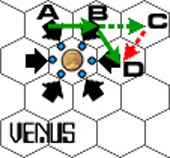
The real fascinating bit, and the part that got me to shell out for my own copy of the game, is how the game handles orbits: as a natural consequence of the simple rules the game allows you to park your ships spinning around a planet with no expenditure of fuel. Exactly like real life. If you want the details, I highly suggest you click over to Project Rho and read about it yourself--I'm not going to recap it here.
The only trouble is that you're stuck with a fixed number of gravity hexes. Imagine you wanted to draw a gravity arrow mid hex C. It'd point directly at the planet, but unfortunately not directly at another hex. You'd screw up your movement going through there as you wouldn't land in the middle of another hex. So if I want to make other, interesting battlefields I can't use the system as is. Especially since I want ships to accelerate at different speeds. You can't move in fractional hexes, so you'd have to have your faster ships move more hexes, which diminishes the value of a block of six gravity hexes; it's too easy to go around.
If I was laying the battle out on a physical board then I doubt I could come up with a better system than Triplanetary runs. On the other hand, why am I constraining myself to a physical board? I'm not going to make it into a video game, but there are advantages to going part way. Let's say we keep time discrete, measured in units of turns, but make space continuous. (As a side note, most video games don't even go there. They make time and space both discrete, or both continuous). What does that do for us?
To start with, it neatly solves the problem of fractional hexes, by allowing fractional hexes. This in turn allows much more flexibility in constructing gravity fields for the ships to fight in. Imagine, for example, a large and long rectangle, with Mars forming the lower right corner. The closer your spaceships get to Mars, the larger effect gravity has on their movements. On the other side of the board though, there isn't much effect at all. But since we're letting the computer worry about it we can still factor it into the result. It also allows fractional movement. Different ships can have different accelerations and still be neatly included on the board without having to worry about it.
The computer also allows us to dynamically track distances and odds. If I'm accelerating this way and I'm at that speed already, how likely am I to hit that guy doing similar things in other directions? If I were figuring this in Gary Gygax's basement forty years ago (has it really been that long?) I'd have to include formula and tables and whatnot, but again, we can let the computer worry about all that. We can even, at little extra cost of expenditure, figure out things like glancing blows (if a nuke detonates at this radius from a ship, how much energy is imparted to their shield?) and the effects of exploding ships on others in their radius. Wonderful stuff, really. I don't have the calculations mapped out yet, but I don't forsee them being too terrible. Or the programming, but that's another issue.
Wednesday, October 6, 2010
The Marvelous Suburbs of Space!
You get a wonderful view of the stars in space. When the sun isn't blinding you to anything else, you can see stars by the tens of thousands, with no terrestrial light pollution to drown them out. And without the filtering effect of the atmosphere, you can see them in their true color; blazing reds and blues and greens. Dr. Ames lay contentedly gazing outwards.
"Twinkle twinkle little star
How I wonder what you are"
Idly, Dr. Ames smiled. Without an atmosphere to distort the light, the stars never twinkle. It's one of the disadvantages of being up above the world so high. Abruptly the view went black. There was another one.
The habitat had sensed an incoming burst of cosmic rays, and flashed it's field on. Dr Ames waited a moment to see if it'd be a short one, and regretfully started to climb down his tree. From his days in med school he knew that the risks of damage from cosmic rays were minuscule, but it's hard to convince people of that. Insurance this and precautionary that and you spoil the doctor's evening, but who cares about that?
Carefully, the garden level of the habitat rotates for precisely one gravity, and a fall out of this tree has just as much chance of breaking bones as your standard one on earth's surface. Well, you're less likely to hit a rock, no profit in importing rocks to your artificial garden. You want precisely one G of gravity for your cultivated bit of space; the plants are used to it and it's easier to engineer your habitat than engineer new plants.
Softly he touched down on the cold earth. Quietly he followed the path walking along the rim of the giant wheel. Expertly he put in his spacesuit, and cycled the airlock. He clicked his carabiner onto the nearby line and jumped. As his foot left the airlock, the field switched off and he could see the stars again. "Murphy is playing games with me tonight" he thought as he drifted down the line. "Ah well, I need some sleep anyway." He clicked off the line and onto another one, this one going around the wheel. He was circling through a residential district, the modular cabins stuck together with flexible tubes and connectors swaying gently in the wind.
Wind? Where did they get wind in space? Hard to figure. As near as Dr. Ames could guess, someone had dropped a couch or something, setting off a shock that was only partially absorbed by the tethers, setting off a wave of vibration throughout the district. As he went around, he watched it, and presently the swaying subsided, a casualty of friction in those tethers.
A short jump later and he was in his own airlock, cycling into his own domicile. Naturally, just as the light flashed green he got the call.
"Dr. Ames, you're needed in surgery. Dr. Ames, please report to surgery in LG." Grimly, he punched the airlock cycle button again. "Reporting." Sleep will have to wait. Murphy and his law are on the prowl tonight.
Back on the spoke line again, he jumped, harder now. Past the domiciles, into the industry section of the habitat. He pulls himself, hand over hand, increasing his speed. The quicker he gets to the low gravity operating room the better his patient's chances of survival. Just as his speed seems too much, that a second medical emergency seems the order of the night, he starts to drag his carabiner along the line, slowing him down. He lands hard, but upright. Into the hub.
The hub is relatively small in the center of the spinning habitat, and it opens onto the zero gravity sections. It's where they manufacture the batteries, and the other technological wonders of space, the stuff that makes these whole cities in the sky economically viable. It's also where the clinic is located. There are advantages to operating in zero g.
The hub proper is mostly an open area. Sure, it's got very low gravity, but it's also got things like the Coriolis effect to mess you up. Two doors open out of the hub, leading to the true zero g environments perpendicular to the wheel. They're as large as you please; plenty of room in space. Dr. Ames picked the leftward one, and went through it. The axle remains put with respect to the wheel, only to Dr. Ames it looked to him as if the axle was spinning and he was rightways. He goes in, rights himself, and looks back to where the hub is now definitely the one doing the spinning. The change in perspective always bothered him.
Shaking it off, he quickly made his way to surgery. As he scrubbed in he got the details. Old Mr. Tukerton's new heart gave out. Dr Ames smiled; Murphy again; he had just put that heart in last week. Those new artificials, they haven't gotten the bugs worked out yet.
Heart surgery hadn't changed much. He made an incision about the size of a quarter in the man's chest, and inserted the fiberoptic cable. Carefully he piloted the cable from a monitor towards the soft plastic organ, plugging it into the dataport. The autodiagnostic filled up the monitor.
Dr. Ames stepped back as the medical cryptologist examined the data. Idly, he watched Mr. Tukerton's blood ooze out of the incision, ball up and float off, to be dexterously sucked into a tube by the nurse. Blood is valuable.
"Well, it isn't good." The technician reported. "His heart was stopped completely, so I set it on manual. Other than that, I can tell you that the software's crashed something fierce. I reset it, deleted the cache files, reset it again, fiddled some more with it, and none of it is working."
You can never trust the first run of a product, thought Dr. Ames. Nothing like months of use by the general public to expose the bugs. Still, none of that changes the fact of a man lying there on the table. "Check with the manufacturer, see if they've got a software update."
"Sent in a query already. Let me see... Yup, known issue. Memory leak in the alpha models. Downloading update... Ok, that should be it."
Dr. Ames looked at the monitor, watching the heart activity return to normal. He sewed up Mr. Tuckerton, and gave his prescription.
"Ok, you should be good to go now. We're going to keep you under observation for a hour or so, until we're sure it isn't a recurring issue. You're going to have to take a couple days of home rest. Make sure you're emergency circuit is on and monitoring your heart. That said, you should be back to work by the end of the week. Any questions?"
There never are.
I got hung up at the end of that story, trying to make an interesting medical drama plot. Something about the heart exploding pacemakers. I then realized that I had very little knowledge of or interest in that sort of procedure, so I cut out the drama in favor of the ending you now have. Exciting, isn't it? Mostly I was going for description anyway.
This is how a space habitat works. Mostly it's the great big suburb in the sky. The company (or whoever is financing it) provides a wheel of gardens on the outside and the industry in the middle. Residents provide their own domicile. Rather than a large, rigid space station the housing comes in the form of modular units, with their own machinery, including standardized hookups into the station. Naturally, this is wasteful of material, but it provides several important benefits. Splitting the station into individual compartments lowers the risk from random meteor strieks; if one house is punctured, none of the others will lose pressure. If something larger and slower hits (like a drunken pilot), the flexible connections allows the station to absorb and distribute the blow, minimizing damage. And vacuum separating compartments does wonders to cancel the noise that would otherwise be ubiquitous.
More importantly, though, are the intangible benefits. First of all, it's a privately owned home. It's not a rented apartment, or a bunk in a barracks. It allows the spaceman time away from his fellows, space and security. It is, in a very important sense, his castle. Secondly, it guarantees his freedom. The whole space station setup is reminiscent of West Viginian coal towns, with a company industry, company store and so forth, with one major distinction. It's not a company house, you can get out whenever you want to by simply disconnecting and flying off on your own power.
These houses (and indeed most of the station) are constructed out of plastics and computer chips. Poetically speaking. Hydrogen, Carbon and Silicon are the most abundant elements already outside of Earth's gravity well, so it's orders of magnitude cheaper to use them than, say, steel. Plastics are mostly hydrocarbon chains, and while orbiting hydrocarbons are rare we can make them from water and space dust in a modified synthetic photosynthesis reaction. Most space debris is silicon, so naturally man has discovered numerous ingenious ways to make essential components out of it. Despite the thinness of the material the inhabitants don't suffer much from cosmic rays. Or perhaps because of it; a cosmic ray is likely to blow right past both walls and your body without stopping of affecting much of anything. Now if you encased yourself in a turtle's shell of steel it might get stopped in the steel, producing a barrage of X-rays to bounce around inside. Not healthy.
The habitats run on power beamed from Solar Station Alpha, and are protected by their own, weak Langston field. It's enough to stop the occasional cosmic ray burst, or solar flare activity, or flying debris. It's not going to be particularly effective against concentrated attack...
"Twinkle twinkle little star
How I wonder what you are"
Idly, Dr. Ames smiled. Without an atmosphere to distort the light, the stars never twinkle. It's one of the disadvantages of being up above the world so high. Abruptly the view went black. There was another one.
The habitat had sensed an incoming burst of cosmic rays, and flashed it's field on. Dr Ames waited a moment to see if it'd be a short one, and regretfully started to climb down his tree. From his days in med school he knew that the risks of damage from cosmic rays were minuscule, but it's hard to convince people of that. Insurance this and precautionary that and you spoil the doctor's evening, but who cares about that?
Carefully, the garden level of the habitat rotates for precisely one gravity, and a fall out of this tree has just as much chance of breaking bones as your standard one on earth's surface. Well, you're less likely to hit a rock, no profit in importing rocks to your artificial garden. You want precisely one G of gravity for your cultivated bit of space; the plants are used to it and it's easier to engineer your habitat than engineer new plants.
Softly he touched down on the cold earth. Quietly he followed the path walking along the rim of the giant wheel. Expertly he put in his spacesuit, and cycled the airlock. He clicked his carabiner onto the nearby line and jumped. As his foot left the airlock, the field switched off and he could see the stars again. "Murphy is playing games with me tonight" he thought as he drifted down the line. "Ah well, I need some sleep anyway." He clicked off the line and onto another one, this one going around the wheel. He was circling through a residential district, the modular cabins stuck together with flexible tubes and connectors swaying gently in the wind.
Wind? Where did they get wind in space? Hard to figure. As near as Dr. Ames could guess, someone had dropped a couch or something, setting off a shock that was only partially absorbed by the tethers, setting off a wave of vibration throughout the district. As he went around, he watched it, and presently the swaying subsided, a casualty of friction in those tethers.
A short jump later and he was in his own airlock, cycling into his own domicile. Naturally, just as the light flashed green he got the call.
"Dr. Ames, you're needed in surgery. Dr. Ames, please report to surgery in LG." Grimly, he punched the airlock cycle button again. "Reporting." Sleep will have to wait. Murphy and his law are on the prowl tonight.
Back on the spoke line again, he jumped, harder now. Past the domiciles, into the industry section of the habitat. He pulls himself, hand over hand, increasing his speed. The quicker he gets to the low gravity operating room the better his patient's chances of survival. Just as his speed seems too much, that a second medical emergency seems the order of the night, he starts to drag his carabiner along the line, slowing him down. He lands hard, but upright. Into the hub.
The hub is relatively small in the center of the spinning habitat, and it opens onto the zero gravity sections. It's where they manufacture the batteries, and the other technological wonders of space, the stuff that makes these whole cities in the sky economically viable. It's also where the clinic is located. There are advantages to operating in zero g.
The hub proper is mostly an open area. Sure, it's got very low gravity, but it's also got things like the Coriolis effect to mess you up. Two doors open out of the hub, leading to the true zero g environments perpendicular to the wheel. They're as large as you please; plenty of room in space. Dr. Ames picked the leftward one, and went through it. The axle remains put with respect to the wheel, only to Dr. Ames it looked to him as if the axle was spinning and he was rightways. He goes in, rights himself, and looks back to where the hub is now definitely the one doing the spinning. The change in perspective always bothered him.
Shaking it off, he quickly made his way to surgery. As he scrubbed in he got the details. Old Mr. Tukerton's new heart gave out. Dr Ames smiled; Murphy again; he had just put that heart in last week. Those new artificials, they haven't gotten the bugs worked out yet.
Heart surgery hadn't changed much. He made an incision about the size of a quarter in the man's chest, and inserted the fiberoptic cable. Carefully he piloted the cable from a monitor towards the soft plastic organ, plugging it into the dataport. The autodiagnostic filled up the monitor.
Dr. Ames stepped back as the medical cryptologist examined the data. Idly, he watched Mr. Tukerton's blood ooze out of the incision, ball up and float off, to be dexterously sucked into a tube by the nurse. Blood is valuable.
"Well, it isn't good." The technician reported. "His heart was stopped completely, so I set it on manual. Other than that, I can tell you that the software's crashed something fierce. I reset it, deleted the cache files, reset it again, fiddled some more with it, and none of it is working."
You can never trust the first run of a product, thought Dr. Ames. Nothing like months of use by the general public to expose the bugs. Still, none of that changes the fact of a man lying there on the table. "Check with the manufacturer, see if they've got a software update."
"Sent in a query already. Let me see... Yup, known issue. Memory leak in the alpha models. Downloading update... Ok, that should be it."
Dr. Ames looked at the monitor, watching the heart activity return to normal. He sewed up Mr. Tuckerton, and gave his prescription.
"Ok, you should be good to go now. We're going to keep you under observation for a hour or so, until we're sure it isn't a recurring issue. You're going to have to take a couple days of home rest. Make sure you're emergency circuit is on and monitoring your heart. That said, you should be back to work by the end of the week. Any questions?"
There never are.
I got hung up at the end of that story, trying to make an interesting medical drama plot. Something about the heart exploding pacemakers. I then realized that I had very little knowledge of or interest in that sort of procedure, so I cut out the drama in favor of the ending you now have. Exciting, isn't it? Mostly I was going for description anyway.
This is how a space habitat works. Mostly it's the great big suburb in the sky. The company (or whoever is financing it) provides a wheel of gardens on the outside and the industry in the middle. Residents provide their own domicile. Rather than a large, rigid space station the housing comes in the form of modular units, with their own machinery, including standardized hookups into the station. Naturally, this is wasteful of material, but it provides several important benefits. Splitting the station into individual compartments lowers the risk from random meteor strieks; if one house is punctured, none of the others will lose pressure. If something larger and slower hits (like a drunken pilot), the flexible connections allows the station to absorb and distribute the blow, minimizing damage. And vacuum separating compartments does wonders to cancel the noise that would otherwise be ubiquitous.
More importantly, though, are the intangible benefits. First of all, it's a privately owned home. It's not a rented apartment, or a bunk in a barracks. It allows the spaceman time away from his fellows, space and security. It is, in a very important sense, his castle. Secondly, it guarantees his freedom. The whole space station setup is reminiscent of West Viginian coal towns, with a company industry, company store and so forth, with one major distinction. It's not a company house, you can get out whenever you want to by simply disconnecting and flying off on your own power.
These houses (and indeed most of the station) are constructed out of plastics and computer chips. Poetically speaking. Hydrogen, Carbon and Silicon are the most abundant elements already outside of Earth's gravity well, so it's orders of magnitude cheaper to use them than, say, steel. Plastics are mostly hydrocarbon chains, and while orbiting hydrocarbons are rare we can make them from water and space dust in a modified synthetic photosynthesis reaction. Most space debris is silicon, so naturally man has discovered numerous ingenious ways to make essential components out of it. Despite the thinness of the material the inhabitants don't suffer much from cosmic rays. Or perhaps because of it; a cosmic ray is likely to blow right past both walls and your body without stopping of affecting much of anything. Now if you encased yourself in a turtle's shell of steel it might get stopped in the steel, producing a barrage of X-rays to bounce around inside. Not healthy.
The habitats run on power beamed from Solar Station Alpha, and are protected by their own, weak Langston field. It's enough to stop the occasional cosmic ray burst, or solar flare activity, or flying debris. It's not going to be particularly effective against concentrated attack...
Friday, August 6, 2010
The mighty Industries of Space!
Going to provide a short update to the terrible secret of space; more background sci-fi.
In the end it was batteries. Batteries that finally broke the confines of gravity and lifted mankind into space. Not literally, of course.
It was a great scientific breakthrough. Using the technique we made batteries that were tens of times stronger. Cellphones that you could talk on for a hundred hours before they needed a recharge. Electric cars that you could drive across the country and never need to refuel. All kinds of medical gear made smaller and more portable, ready to jump off the ambulance and save lives. When I think of how life was before we invented these things I don't understand how they got along. Durable, lasting, portable power sources. How could we do without?
There's a catch of course. There's always a catch. An essential part of the manufacturing process requires microgravity. The same sort of conditions that you could never find on the surface of the earth, that only occurs in orbit. But orbit is oh so expensive to get into.
In the end, it was a country in the Andes mountains that set up the first industry in space. You'd think it'd be America. Or Russia, or China, or even India. All of those countries had the technological edge. They also had safety standards. Don't get me wrong, raw space is incredibly dangerous, you can't get there without some safety devices. But the more developed countries were forced, over time, to adapt to ever more stringent workplace standards. Even China and India, as time wore on. If a company based out of Alabama wanted to get into space, it'd have to comply with so many OSHA standards, file so much paperwork, field such a large legal team and all the other headaches of the business world. Don't get me wrong; those safety standards have their place. Lots of people died to get that first assembler into orbit. Even so, the world will always remember the launching pads of the Altiplano as taking the greatest leap of space exploration since Neal Armstrong took his small step.
One dirty little factory. Six astronauts, working in two man shifts, seven days a week. One dinky little, rickety as all getout shuttle struggling past the iron bands of gravity. And yet, when that shuttle came down... Do you remember Sir Frances Drake? The second ship to circumnavigate the globe. It came back from the far east stuffed with precious metals, jewels, silks and spices. Made his investors into rich men, all from one shipload. Every time that shuttle came down it was like Drake made his triumphant return into London. Those first loads of batteries were worth their weight in gold. Double. Triple.
Sure there were accidents, but never enough to stop them from going back up. The legend goes, I've never confirmed this myself, that whenever the shuttle would explode they hired scores of peasents to scour the countryside for debris, trying to find any batteries that survived intact. I'd believe it; one of those things was enough to pay for half a dozen searchers.
It didn't last long. You know what happens when you start making money hand over fist? A lot of sharp company pays attention, and starts copying you. You'd be amazed at how quickly those environmental concerns and safety regulations got waived once people realized how much money there was to be made. And when you've got your department of defense pressing down on you to not let us be dependent on foreign suppliers, well, you've got incentives. To their credit America had much more efficient and much safer facilities, but nobody cares about second place.
Soon orbital facilities were popping up like dandelions in spring. All over orbit you'd find another countries premier battery manufacturing company doing there best to get in on the action. It was a real headache for the diplomats and air traffic controllers, let me tell you. A veritable gold rush in orbit. Actually, the gold rush analogy is pretty good.
You know who gets rich in a gold rush? The suppliers. The prospectors in a California soon-to-be ghost town never really get rich and go back east like they always planned. You know who makes the money? That lady who bakes the pies they eat when they're living high. Those orbital workers got paid plenty for the strain and risks associated with the job. Are you surprised they wanted a place to spend it?
They followed the same pattern. The first one was small and crude, the next one was bigger and flashier. And then it grew. You reach a critical point where you're putting enough people into a place and suddenly you need more people up there to support them. And good heavens what do you do when people start having babies? The first true city in space was named Boomtown, set in geosynchronous orbit over Arizona. The manufacturing satellites had to be kept higher still, but once you're that high in orbit it's just a small energy expenditure to jump up and down, when your satellite swings over. And the strategic location-- close to Vegas, ensured that they got the bulk of the tourist trade.
As supply rose, the batteries got cheaper and cheaper. Tourists suddenly provided the next major revenue stream. The free market had driven the costs of pushing a payload into orbit ever downward, and it liberalized space tourism from the ultra-rich to merely the very well off. If you raise a boy on the old Heinlein stories then he's always going to want to get into space. There's plenty of cash to be made fulfilling that dream. Soon another industrial boom fueled the expansion into space, and another.
In all this time, the biggest expense was always getting men and material up into orbit. Asteroid farming naturally followed. Why go to the expense of shipping your copper up from the surface when you can crack it out of a nearby space rock? First you extract the metals from the ore. extracted from the rock. They grind up the chunks of leftover stone and chemically them into workable soil. Even the slang gets reprocessed. Men are awfully clever about using every part of the buffalo when the situation calls for it.
They also dug mines on the surface of the moon. At 1/6th earth surface gravity, the moon provided a compromise between the vast distances to the asteroids and the heavy energy burden of lifting them off from Earth. Much later, foundries were established on Mercury. It's much more difficult, but when the money's there, men brave all sorts of hazards and difficulties to grab it. They once asked J. Thompson Martin, the capitalist who commissioned the first mission prospecting the asteroids, why he went out to such great distances. He famously responded "Lady, if I could see a dollar's profit on the dark side of Pluto I'd walk the entire way if need be."
In the end that's how it happened. There was money in space, so we went there. And all it took was batteries.
Well, there you go. There's the explanation for why we're up in space, and why we have the different structures and industries and whatnot up there. Briefly, I'm going to talk about this in game terms.
You've got three kinds of installations up there. Space industries are the first. Large chunks of machinery, robotized wherever possible but never 100%. The second are Space Habitats, the cities where people live or at least try too. Like Boomtown. The third kind are Space Stations, which are more military in nature. They're the only ones that come armed, but boy do they ever!
I expect that you'll be able to recruit personnel out of the space habitats, and assemble weapons or some such from space industries. Furthermore they're going to be important strategic concepts. Of course, that's going to have to wait until I start figuring out resource types and uses and so forth. Another day... another day.
In the end it was batteries. Batteries that finally broke the confines of gravity and lifted mankind into space. Not literally, of course.
It was a great scientific breakthrough. Using the technique we made batteries that were tens of times stronger. Cellphones that you could talk on for a hundred hours before they needed a recharge. Electric cars that you could drive across the country and never need to refuel. All kinds of medical gear made smaller and more portable, ready to jump off the ambulance and save lives. When I think of how life was before we invented these things I don't understand how they got along. Durable, lasting, portable power sources. How could we do without?
There's a catch of course. There's always a catch. An essential part of the manufacturing process requires microgravity. The same sort of conditions that you could never find on the surface of the earth, that only occurs in orbit. But orbit is oh so expensive to get into.
In the end, it was a country in the Andes mountains that set up the first industry in space. You'd think it'd be America. Or Russia, or China, or even India. All of those countries had the technological edge. They also had safety standards. Don't get me wrong, raw space is incredibly dangerous, you can't get there without some safety devices. But the more developed countries were forced, over time, to adapt to ever more stringent workplace standards. Even China and India, as time wore on. If a company based out of Alabama wanted to get into space, it'd have to comply with so many OSHA standards, file so much paperwork, field such a large legal team and all the other headaches of the business world. Don't get me wrong; those safety standards have their place. Lots of people died to get that first assembler into orbit. Even so, the world will always remember the launching pads of the Altiplano as taking the greatest leap of space exploration since Neal Armstrong took his small step.
One dirty little factory. Six astronauts, working in two man shifts, seven days a week. One dinky little, rickety as all getout shuttle struggling past the iron bands of gravity. And yet, when that shuttle came down... Do you remember Sir Frances Drake? The second ship to circumnavigate the globe. It came back from the far east stuffed with precious metals, jewels, silks and spices. Made his investors into rich men, all from one shipload. Every time that shuttle came down it was like Drake made his triumphant return into London. Those first loads of batteries were worth their weight in gold. Double. Triple.
Sure there were accidents, but never enough to stop them from going back up. The legend goes, I've never confirmed this myself, that whenever the shuttle would explode they hired scores of peasents to scour the countryside for debris, trying to find any batteries that survived intact. I'd believe it; one of those things was enough to pay for half a dozen searchers.
It didn't last long. You know what happens when you start making money hand over fist? A lot of sharp company pays attention, and starts copying you. You'd be amazed at how quickly those environmental concerns and safety regulations got waived once people realized how much money there was to be made. And when you've got your department of defense pressing down on you to not let us be dependent on foreign suppliers, well, you've got incentives. To their credit America had much more efficient and much safer facilities, but nobody cares about second place.
Soon orbital facilities were popping up like dandelions in spring. All over orbit you'd find another countries premier battery manufacturing company doing there best to get in on the action. It was a real headache for the diplomats and air traffic controllers, let me tell you. A veritable gold rush in orbit. Actually, the gold rush analogy is pretty good.
You know who gets rich in a gold rush? The suppliers. The prospectors in a California soon-to-be ghost town never really get rich and go back east like they always planned. You know who makes the money? That lady who bakes the pies they eat when they're living high. Those orbital workers got paid plenty for the strain and risks associated with the job. Are you surprised they wanted a place to spend it?
They followed the same pattern. The first one was small and crude, the next one was bigger and flashier. And then it grew. You reach a critical point where you're putting enough people into a place and suddenly you need more people up there to support them. And good heavens what do you do when people start having babies? The first true city in space was named Boomtown, set in geosynchronous orbit over Arizona. The manufacturing satellites had to be kept higher still, but once you're that high in orbit it's just a small energy expenditure to jump up and down, when your satellite swings over. And the strategic location-- close to Vegas, ensured that they got the bulk of the tourist trade.
As supply rose, the batteries got cheaper and cheaper. Tourists suddenly provided the next major revenue stream. The free market had driven the costs of pushing a payload into orbit ever downward, and it liberalized space tourism from the ultra-rich to merely the very well off. If you raise a boy on the old Heinlein stories then he's always going to want to get into space. There's plenty of cash to be made fulfilling that dream. Soon another industrial boom fueled the expansion into space, and another.
In all this time, the biggest expense was always getting men and material up into orbit. Asteroid farming naturally followed. Why go to the expense of shipping your copper up from the surface when you can crack it out of a nearby space rock? First you extract the metals from the ore. extracted from the rock. They grind up the chunks of leftover stone and chemically them into workable soil. Even the slang gets reprocessed. Men are awfully clever about using every part of the buffalo when the situation calls for it.
They also dug mines on the surface of the moon. At 1/6th earth surface gravity, the moon provided a compromise between the vast distances to the asteroids and the heavy energy burden of lifting them off from Earth. Much later, foundries were established on Mercury. It's much more difficult, but when the money's there, men brave all sorts of hazards and difficulties to grab it. They once asked J. Thompson Martin, the capitalist who commissioned the first mission prospecting the asteroids, why he went out to such great distances. He famously responded "Lady, if I could see a dollar's profit on the dark side of Pluto I'd walk the entire way if need be."
In the end that's how it happened. There was money in space, so we went there. And all it took was batteries.
Well, there you go. There's the explanation for why we're up in space, and why we have the different structures and industries and whatnot up there. Briefly, I'm going to talk about this in game terms.
You've got three kinds of installations up there. Space industries are the first. Large chunks of machinery, robotized wherever possible but never 100%. The second are Space Habitats, the cities where people live or at least try too. Like Boomtown. The third kind are Space Stations, which are more military in nature. They're the only ones that come armed, but boy do they ever!
I expect that you'll be able to recruit personnel out of the space habitats, and assemble weapons or some such from space industries. Furthermore they're going to be important strategic concepts. Of course, that's going to have to wait until I start figuring out resource types and uses and so forth. Another day... another day.
Friday, June 11, 2010
Solar Station Alpha
Been a little bit since I've updated the Terrible Secret of Space. If you don't remember, the Terrible Secret of Space is a game I'm designing expressly to be played over a blog. It covers a war between Earth and it's colonies in the solar system (played by you, the internet at large) and the evil invading aliens (played by me, the Dungeon Master. Mua ha ha ha.) Anyways, I've talked a lot about movement, and a bunch about the shields the ships will use. (Seriously, look up the Langston Field blog posts. They're very... wordy.) Today I'm going to do a little more traditional world building. Behold as I deploy Italics!
The sun never burned so harsh over Arabia as it did that morning over Solar Station Alpha. Of course Arabia had the advantage of position; located on the equator as it was it was still millions of miles farther out than the gigantic space station orbiting the sun. And "morning" is a deceptive term on a space station that never, ever turns it's massive solar panels away from the sun.
Orbiting perpendicular to the elliptic plane the planets all inhabited, Solar Station Alpha existed entirely to harvest the beating energies of our native star. It concentrates the energy into titanic beams of power that it shoots to relay satellites in other parts of the solar system which ultimately beam the power down to those who use it.
On Earth they don't use beam power. On Earth electricity is cheap. If you don't want to burn hydrocarbons or split Uranium you can fire up a fusion reactor to supply the demands of your cities. No, energy is cheap on Earth.
On the Moon it's a different story. On the Moon you have to pull your water up a gravity well at great expense, or mine it laboriously from the precious few ice crystals you'll find under the lunar dust. What water you do have is too important for drinking and bathing and producing rocket fuel to waste on merely generating electricity. No, that's why we beam power in.
We could set up the solar cells on the surface of the moon. The trouble with that is that the moon has a night that lasts several weeks; we'd need a lot of very powerful batteries supported by double the acreage of solar cells since you need to pull in twice the power every "day". On Solar Station Alpha, by contrast, there is no night. It beams it's power out continuously to relay satellites around the moon. The relay satellites also orbit perpendicular to the elliptic, but they don't orbit parallel to Solar Station Alpha. This angled approach lets them be constantly be in line of sight with the Sun and also intermittently cover the entire surface of the moon. It's that intermittent nature that requires there to be multiple satellites.
As every city requires power continuously, Solar Station Alpha cannot switch it's beams from target to target arbitrarily. So one emitter is built for each target. Currently there are three emitters for the relay sattelites around the moon, several for various space stations and space habitats and one brand new one for the colonies on Mars.
So we've got a massive solar power station orbiting the sun. It beams power out to other stations orbiting the moon, or other space stations and habitats directly. The question is, of course, what are the doomsday applications of this device? Let's ask Mr. Burns:
"Since the beginning of time man has yearned to destroy the sun. I will do the next best thing...block it out!" Monty Burns, Who shot Mr. Burns part I
Sure, if you could maneuver this into a different orbit you could block the sun out, causing owls to deafen us with incessant hooting and all. Still, there are much more interesting ways to show the world who's boss. Suppose that you had one of these and the beam missed. If you pump huge amounts of energy into stuff that isn't designed to accommodate it you're gonna have stuff melting, or fires starting or all sorts of neat stuff. But you knew that already; why else did you put all those elementary schools next to the microwave power plant in Sim City 2000? (Projecting? I'm not projecting. You're projecting!)
Anyway, yeah, you could redirect the beam from it's intended target and use it as a weapon. Unfortunately it won't work that well against spaceships; assuming that the spaceship is out past Mars you've got a real problem what with light speed delays and knowing where your target is, and where it's going to be when the beam hits it. You've got a much better chance at hitting stationary targets. Well, relatively stationary targets. I mean you can hardly say something is standing still when it's on a rotating planet which is also revolving around the sun. But the important thing is you can predict where the object is going to be, therefore you can hit it. (I'm assuming these beams can be targeted very accurately.) This won't accomplish much; in the case of an enemy takeover of Solar Station Alpha the cities of Earth would put up their Langston fields, and you couldn't do much. Sure, you could focus fire on one for an entire day, but it'd have a whole night to cool off.
What you could do is lay waste to the smaller, provincial towns. This won't accomplish much for destroying infrastructure but it would be a good way to get the people clamoring for the military to shoot you out of the sky. You could lay waste to a continent one acre at a time; starting wildfires and generally trying to overpower their firefighters. Seems sort of petty, actually.
Probably more interesting, how is this system open to attack? Pretty obviously if they take out Solar Station Alpha then a whole number of spots in the solar system are deprived of energy. We can presume they have backup generators for essential things like emergency lighting and Langston Generators, but it'll certainly shut down any heavy industry in the afflicted city or space station. You can get this effect on a more limited scale by shooting down one of the relay satellites.
Which of course means that Solar Station Alpha and the relay stations will all have Langston fields of their own, just like everything else. I mean, at this point I practically have one on my dog's collar. The satellites can all operate with shields up; the field allows holes to be punched in it to emit important things like laser blasts. Trouble is, that'll decrease the efficiency of the operation; wearing a shield makes it harder to tell precisely where your sending your beams of energy; increases the chance for a catastrophic failure. Or, if your target has his shields up it won't be much of a disaster, but the stream of power will be interrupted. The intermittent blackouts won't shut industry down but they will cut down on your efficiency.
Well, that makes enough for one post. Next time I might even get into the difference between space habitats and space stations.
The sun never burned so harsh over Arabia as it did that morning over Solar Station Alpha. Of course Arabia had the advantage of position; located on the equator as it was it was still millions of miles farther out than the gigantic space station orbiting the sun. And "morning" is a deceptive term on a space station that never, ever turns it's massive solar panels away from the sun.
Orbiting perpendicular to the elliptic plane the planets all inhabited, Solar Station Alpha existed entirely to harvest the beating energies of our native star. It concentrates the energy into titanic beams of power that it shoots to relay satellites in other parts of the solar system which ultimately beam the power down to those who use it.
On Earth they don't use beam power. On Earth electricity is cheap. If you don't want to burn hydrocarbons or split Uranium you can fire up a fusion reactor to supply the demands of your cities. No, energy is cheap on Earth.
On the Moon it's a different story. On the Moon you have to pull your water up a gravity well at great expense, or mine it laboriously from the precious few ice crystals you'll find under the lunar dust. What water you do have is too important for drinking and bathing and producing rocket fuel to waste on merely generating electricity. No, that's why we beam power in.
We could set up the solar cells on the surface of the moon. The trouble with that is that the moon has a night that lasts several weeks; we'd need a lot of very powerful batteries supported by double the acreage of solar cells since you need to pull in twice the power every "day". On Solar Station Alpha, by contrast, there is no night. It beams it's power out continuously to relay satellites around the moon. The relay satellites also orbit perpendicular to the elliptic, but they don't orbit parallel to Solar Station Alpha. This angled approach lets them be constantly be in line of sight with the Sun and also intermittently cover the entire surface of the moon. It's that intermittent nature that requires there to be multiple satellites.
As every city requires power continuously, Solar Station Alpha cannot switch it's beams from target to target arbitrarily. So one emitter is built for each target. Currently there are three emitters for the relay sattelites around the moon, several for various space stations and space habitats and one brand new one for the colonies on Mars.
So we've got a massive solar power station orbiting the sun. It beams power out to other stations orbiting the moon, or other space stations and habitats directly. The question is, of course, what are the doomsday applications of this device? Let's ask Mr. Burns:
"Since the beginning of time man has yearned to destroy the sun. I will do the next best thing...block it out!" Monty Burns, Who shot Mr. Burns part I
Sure, if you could maneuver this into a different orbit you could block the sun out, causing owls to deafen us with incessant hooting and all. Still, there are much more interesting ways to show the world who's boss. Suppose that you had one of these and the beam missed. If you pump huge amounts of energy into stuff that isn't designed to accommodate it you're gonna have stuff melting, or fires starting or all sorts of neat stuff. But you knew that already; why else did you put all those elementary schools next to the microwave power plant in Sim City 2000? (Projecting? I'm not projecting. You're projecting!)
Anyway, yeah, you could redirect the beam from it's intended target and use it as a weapon. Unfortunately it won't work that well against spaceships; assuming that the spaceship is out past Mars you've got a real problem what with light speed delays and knowing where your target is, and where it's going to be when the beam hits it. You've got a much better chance at hitting stationary targets. Well, relatively stationary targets. I mean you can hardly say something is standing still when it's on a rotating planet which is also revolving around the sun. But the important thing is you can predict where the object is going to be, therefore you can hit it. (I'm assuming these beams can be targeted very accurately.) This won't accomplish much; in the case of an enemy takeover of Solar Station Alpha the cities of Earth would put up their Langston fields, and you couldn't do much. Sure, you could focus fire on one for an entire day, but it'd have a whole night to cool off.
What you could do is lay waste to the smaller, provincial towns. This won't accomplish much for destroying infrastructure but it would be a good way to get the people clamoring for the military to shoot you out of the sky. You could lay waste to a continent one acre at a time; starting wildfires and generally trying to overpower their firefighters. Seems sort of petty, actually.
Probably more interesting, how is this system open to attack? Pretty obviously if they take out Solar Station Alpha then a whole number of spots in the solar system are deprived of energy. We can presume they have backup generators for essential things like emergency lighting and Langston Generators, but it'll certainly shut down any heavy industry in the afflicted city or space station. You can get this effect on a more limited scale by shooting down one of the relay satellites.
Which of course means that Solar Station Alpha and the relay stations will all have Langston fields of their own, just like everything else. I mean, at this point I practically have one on my dog's collar. The satellites can all operate with shields up; the field allows holes to be punched in it to emit important things like laser blasts. Trouble is, that'll decrease the efficiency of the operation; wearing a shield makes it harder to tell precisely where your sending your beams of energy; increases the chance for a catastrophic failure. Or, if your target has his shields up it won't be much of a disaster, but the stream of power will be interrupted. The intermittent blackouts won't shut industry down but they will cut down on your efficiency.
Well, that makes enough for one post. Next time I might even get into the difference between space habitats and space stations.
Monday, May 17, 2010
The Langston Field and Thermodynamics
Here I'm analyzing some further implications of the Langston Field. We're going to get into some thermodynamics and what that implies for spaceships and weapons in the Terrible Secret of Space.
I stated in the last post that the field radiates like a black body. The question is, what exactly does that mean? Black body radiation describes the way that stuff gives off light depending on how hot it is. The interesting thing about black body radiation is that it doesn't depend on what size, or shape, or color, or even if the object in question is a communist. It only depends on the temperature. An incandescent light bulb shines because that filament is really, really hot. You're emitting infra-red radiation right now, you can't tell because you eyes don't see at that wavelength. The SWAT team that just cut your power and battered down your door can see them, though. Their heat vision goggles sense the heat you're emitting, and can tell by the wavelength the difference between you (100 degrees) and your nightstand (70 degrees.)
So we said that the shields shift up the color spectrum as they take damage, taking in heat and emitting it like a black body. But since black body's don't care what's doing the emitting, we can figure out how hot the shield is. Let's say the ship blows up when it's emitting light at a wavelength of about 400 nanometers. That's in the deep purple region of colors. Just before it overloads, the shield is going to hit a temperature of about 7250 kelvin. That's plenty enough to melt and boil tungsten or what have you. There are some problems raised by that; how do you see out of one of these shields? I mean, it's black. It stops light. There's no way to get it to stop "dangerous" light like lasers but not "useful" light like, oh, the stuff that shows you where your opponent is. You could build cameras on metal poles and stick them through the shields (the shields will allow matter to pass, and electric signals should be able to get through). And then someone actually shoots you enough, your cameras melt off and you're blind again. Well before the explosion point.
I'm thinking the answer to that is that you can open holes in your own shield. This is suboptimal in combat because someone might try to shoot through your holes, but necessary. I mean, you've got to shoot your laser cannons out, right? Blasting it into your own shield seems counterproductive. Also, your fusion drive has to shoot materials out the back, if they get caught in the shield you won't go anywhere.
That's not the biggest problem, though. Remember how black bodies radiate solely based on their temperature? Exactly how much do they radiate? There's an equation for that (I won't post it, partly because you can't be bothered with it and partly because I can't be bothered with getting the Greek symbols and formatting equations in a text file). The amount of energy emitted is proportional to the fourth power of the temperature. Not just squared or cubed, raised to the fourth power. What's 7250 to the fourth? Roughly 2.7 quadrillion (thanks Windows Calculator!). Quadrillion, as in even the federal deficit hasn't gotten that large yet. The proportion factors are all pretty small decimals, but we end up with a huge number nonetheless. Let's say a spaceship has a spherical shield with a 100 meter radius. Now heat that ship up to the explosion point. Just before it's exploding that ship will be emitting a kiloton of energy in black body radiation every second.
A kiloton of energy every second. Remember Hiroshima? In one minute a spaceship like that could duplicate the effects.
Now let's go over the disturbing implications of that. And not just it's uses as a superweapon. (If you're gonna do that, why not just lob the atom bombs and cut out the middle man?) If the spaceship is radiating kilotons of energy, how much energy do you have to put in to keep pushing the shield temperature up? At some point you're lobbing atom bombs at it to make sure the damn thing doesn't cool down on you, let alone cook off. You can probably do it with H bombs, but your laser batteries might fall short. Weapons are going to have to be culled because we're gonna have to ask ourselves "neat as this is, is it really as destructive as an atom bomb?". Naturally this saddens me.
Now, if you're emitting that much energy, how close do I want to fly to you? Forget the explosion (for the moment) My shields will be heating up just going by. Probably not going to be a major concern for another ship. But let's say we're having a battle in orbit over the planet. You detonate enough atom bombs directly above the atmosphere and you'll pump in enough heat to affect the weather. I haven't done any calculations about this, but you might start fires or kill crops or some such.
For that matter, what about using a shield as a weapon? If you take a starship, nuke it profusely and then send it hurtling through someone's atmosphere, set so that the final collision will overload the shield you can create an explosion that makes your garden variety atomic bomb weep. You've got all the energy of those nukes plus the energy of a giant freaking meteor hitting stored in the shield. You could raze continents with those. Y'know, as if you couldn't with enough nukes already.
(There are also conservation of momentum problems here that I didn't consider. Particle hits shield makes sense. Shield hits planet makes less sense. Does it slow the planet enough to overload the shield? For collisions of any velocity?)
That brings up another question. How much energy exactly can one of these shields absorb? I'm gonna have to talk about Specific Heat here, and how it's totally inapplicable to the problem at hand but I'm going to use it nonetheless. Specific heat is a measure of how much energy something can hold. For a given mass, different materials will hold different amounts of heat. An experiment! Take a mass of iron, boil it in water. Take an equal mass of water. Dump them both out on a snowbank, and see which one melts more snow. You'll get more melting from the water because even though they're undergoing the same change in temperature the water can hold more heat than the iron. It has a higher specific heat.
Now drop an atom bomb on that snowbank. The snow will melt and vaporize. So will that chunk of iron. And anything else in the nearby area. You could build a chunk of iron large enough to not melt when you hit it with a nuke, but it'd take a lot of iron. (At least you could build one if the heat conducted at an infinite rate; as it stands the nuke is still going to leave a crater.) The question is, what specific heat do those fancy schmancy Langston fields have, what with the not cooking off with the first nuke that comes their way? Well, it's hard to say. Y'see, the shields are force field, and they don't exactly have a mass. (Ok, all energy has a mass, thanks Mr. Einstein, but I can't wrap my head around asking about the specific heat of a quantity of heat. The question makes even less sense than my twisted diction.) Specific heat depends on having a mass. So the question doesn't even apply.
But, as I stated earlier, I'm not going to let that stand in the way of Science! We can work out a volume for these shields (say a 3 meter shell on a 97 meter warship to get that 100 meter shield I was talking about). We can throw in a "density" factor so that we can work out an effective mass, and from there we can figure out exactly what sort of heat capacity the shields have to have. If some practical joker took away your Langston field and substituted water for it, it'd have a known density (1) and heat capacity (4 point something). We could calculate how much energy the water would absorb before it'd heat to the requisite 7250 kelvin. Assuming, of course, the wildly unphysical notion that the water would stick around to be heated and not boil off the very first chance it gets. But the heat, the heat could be provided by a single atom bomb, blasting through your shields and wrecking your ship.
This will not do. Fortunately, our shields aren't made out of water, but are pulled form the figurative aether. By fiddling with the heat capacity factor we can work out a shield that will not only survive the first nuke but several more, changing into pretty colors and radiating energy and doing all the other wonderful things I'm counting on the Langston field to do. Roughly, I expect this handwaved heat capacity to be a hundred million times larger than that of water.
I doubt this is the last I have to say about Langston fields. But it's good enough for now.
I stated in the last post that the field radiates like a black body. The question is, what exactly does that mean? Black body radiation describes the way that stuff gives off light depending on how hot it is. The interesting thing about black body radiation is that it doesn't depend on what size, or shape, or color, or even if the object in question is a communist. It only depends on the temperature. An incandescent light bulb shines because that filament is really, really hot. You're emitting infra-red radiation right now, you can't tell because you eyes don't see at that wavelength. The SWAT team that just cut your power and battered down your door can see them, though. Their heat vision goggles sense the heat you're emitting, and can tell by the wavelength the difference between you (100 degrees) and your nightstand (70 degrees.)
So we said that the shields shift up the color spectrum as they take damage, taking in heat and emitting it like a black body. But since black body's don't care what's doing the emitting, we can figure out how hot the shield is. Let's say the ship blows up when it's emitting light at a wavelength of about 400 nanometers. That's in the deep purple region of colors. Just before it overloads, the shield is going to hit a temperature of about 7250 kelvin. That's plenty enough to melt and boil tungsten or what have you. There are some problems raised by that; how do you see out of one of these shields? I mean, it's black. It stops light. There's no way to get it to stop "dangerous" light like lasers but not "useful" light like, oh, the stuff that shows you where your opponent is. You could build cameras on metal poles and stick them through the shields (the shields will allow matter to pass, and electric signals should be able to get through). And then someone actually shoots you enough, your cameras melt off and you're blind again. Well before the explosion point.
I'm thinking the answer to that is that you can open holes in your own shield. This is suboptimal in combat because someone might try to shoot through your holes, but necessary. I mean, you've got to shoot your laser cannons out, right? Blasting it into your own shield seems counterproductive. Also, your fusion drive has to shoot materials out the back, if they get caught in the shield you won't go anywhere.
That's not the biggest problem, though. Remember how black bodies radiate solely based on their temperature? Exactly how much do they radiate? There's an equation for that (I won't post it, partly because you can't be bothered with it and partly because I can't be bothered with getting the Greek symbols and formatting equations in a text file). The amount of energy emitted is proportional to the fourth power of the temperature. Not just squared or cubed, raised to the fourth power. What's 7250 to the fourth? Roughly 2.7 quadrillion (thanks Windows Calculator!). Quadrillion, as in even the federal deficit hasn't gotten that large yet. The proportion factors are all pretty small decimals, but we end up with a huge number nonetheless. Let's say a spaceship has a spherical shield with a 100 meter radius. Now heat that ship up to the explosion point. Just before it's exploding that ship will be emitting a kiloton of energy in black body radiation every second.
A kiloton of energy every second. Remember Hiroshima? In one minute a spaceship like that could duplicate the effects.

Now let's go over the disturbing implications of that. And not just it's uses as a superweapon. (If you're gonna do that, why not just lob the atom bombs and cut out the middle man?) If the spaceship is radiating kilotons of energy, how much energy do you have to put in to keep pushing the shield temperature up? At some point you're lobbing atom bombs at it to make sure the damn thing doesn't cool down on you, let alone cook off. You can probably do it with H bombs, but your laser batteries might fall short. Weapons are going to have to be culled because we're gonna have to ask ourselves "neat as this is, is it really as destructive as an atom bomb?". Naturally this saddens me.
Now, if you're emitting that much energy, how close do I want to fly to you? Forget the explosion (for the moment) My shields will be heating up just going by. Probably not going to be a major concern for another ship. But let's say we're having a battle in orbit over the planet. You detonate enough atom bombs directly above the atmosphere and you'll pump in enough heat to affect the weather. I haven't done any calculations about this, but you might start fires or kill crops or some such.
For that matter, what about using a shield as a weapon? If you take a starship, nuke it profusely and then send it hurtling through someone's atmosphere, set so that the final collision will overload the shield you can create an explosion that makes your garden variety atomic bomb weep. You've got all the energy of those nukes plus the energy of a giant freaking meteor hitting stored in the shield. You could raze continents with those. Y'know, as if you couldn't with enough nukes already.
(There are also conservation of momentum problems here that I didn't consider. Particle hits shield makes sense. Shield hits planet makes less sense. Does it slow the planet enough to overload the shield? For collisions of any velocity?)
That brings up another question. How much energy exactly can one of these shields absorb? I'm gonna have to talk about Specific Heat here, and how it's totally inapplicable to the problem at hand but I'm going to use it nonetheless. Specific heat is a measure of how much energy something can hold. For a given mass, different materials will hold different amounts of heat. An experiment! Take a mass of iron, boil it in water. Take an equal mass of water. Dump them both out on a snowbank, and see which one melts more snow. You'll get more melting from the water because even though they're undergoing the same change in temperature the water can hold more heat than the iron. It has a higher specific heat.
Now drop an atom bomb on that snowbank. The snow will melt and vaporize. So will that chunk of iron. And anything else in the nearby area. You could build a chunk of iron large enough to not melt when you hit it with a nuke, but it'd take a lot of iron. (At least you could build one if the heat conducted at an infinite rate; as it stands the nuke is still going to leave a crater.) The question is, what specific heat do those fancy schmancy Langston fields have, what with the not cooking off with the first nuke that comes their way? Well, it's hard to say. Y'see, the shields are force field, and they don't exactly have a mass. (Ok, all energy has a mass, thanks Mr. Einstein, but I can't wrap my head around asking about the specific heat of a quantity of heat. The question makes even less sense than my twisted diction.) Specific heat depends on having a mass. So the question doesn't even apply.
But, as I stated earlier, I'm not going to let that stand in the way of Science! We can work out a volume for these shields (say a 3 meter shell on a 97 meter warship to get that 100 meter shield I was talking about). We can throw in a "density" factor so that we can work out an effective mass, and from there we can figure out exactly what sort of heat capacity the shields have to have. If some practical joker took away your Langston field and substituted water for it, it'd have a known density (1) and heat capacity (4 point something). We could calculate how much energy the water would absorb before it'd heat to the requisite 7250 kelvin. Assuming, of course, the wildly unphysical notion that the water would stick around to be heated and not boil off the very first chance it gets. But the heat, the heat could be provided by a single atom bomb, blasting through your shields and wrecking your ship.
This will not do. Fortunately, our shields aren't made out of water, but are pulled form the figurative aether. By fiddling with the heat capacity factor we can work out a shield that will not only survive the first nuke but several more, changing into pretty colors and radiating energy and doing all the other wonderful things I'm counting on the Langston field to do. Roughly, I expect this handwaved heat capacity to be a hundred million times larger than that of water.
I doubt this is the last I have to say about Langston fields. But it's good enough for now.
Wednesday, May 5, 2010
The Langston Field
Been a bit since I last advanced the Terrible Secret of Space. If you'll recall, last time I was working out some necessary consequences of having spaceships that travel around the solar system. Basically, if you can get a ship up to speed, it makes a great rock to hurl at those who would oppose you. Or those who might think of opposing you. Or those who might think of looking at you funny. Or... I'd better get off this train of thought.
Specifically, at the close of my last post I didn't have a satisfactory reason for why the evil invading aliens couldn't strap a drive on just any old rock and blast capital ships out of the sky or selectively target important military installations. After duly considering the problem, I've got the solution: Cheat!
I'm stealing the Langston Field from the novel The Mote in God's Eye by Larry Niven and Jerry Pournelle. The aforementioned field drains energy from objects in motion, including such extremely high energy objects as plasma from fusion torpedoes or photons from laser cannons. Importantly though, the book also works out the restrictions. The field has to absorb that energy, which it disposes of by radiating outwards as a black body. If it can't radiate the energy faster than it takes it in, the shield heats up until it overloads, destroying the ship inside.
This has all sorts of useful applications for a boardgame. For starters, it neatly allows us to sidestep the issue of throwing rocks at capital ships; the shields will be able to survive that sort of attack. Doubly so for ground installations. It also provides a handy way to track damage done to ships; in the book the shields remained black until enough energy is absorbed that it starts changing color, from red on up the rainbow. Makes a pretty convenient way to define and measure hit points.
So what do we actually know about the shields?
1) The shields absorb energy. They reradiate it like blackbody radiation. The specific heat of the shields must be proportionally huge, they can absorb large amounts of energy.
2) They absorb momentum proportional to the cube of the incoming velocity. Which means they absorb a lot more energy from, say, an incoming particle beam than from an object moving at slow speeds.
3) They're generally spherical in shape. This probably works to our advantage otherwise, seeing as a sphere is best for radiating away excess energy.
4) Small holes can be punched through the shield. This allows useful things like laser batteries or the fusion reaction to get out.
5) Some energy gets through; there's a lot of talk in the book about how the ships get shaken about in major fleet actions, and about necessary repairs.
6) The shields dampen all motion. If you get stuck in one, it'll dampen the beating of your heart etc.
7) Absorbing energy is really useful if you want an ultra efficient sci-fi star drive. Say, the sort of thing that could stand .1g over extended periods of time. Not sure that I'm going to get into a detailed explanation of how the engines work, but it's nice to remember.
8) Shields have some thickness. They take up a volume of space. They are fields though, so they don't exclude matter from taking up the same space.
9) Until a shield overloads, it mostly radiates it's energy outward. I don't know why this is. Probably storytelling necessity. Possibly I'm screwing up my physics.
10) Not stated but implied by the logic, ground based shields will be more efficient than space based ones; they can lose energy by conduction with the ground rather than just radiation.
11) When a shield overloads the energy will The overloaded Langston field is enough to vaporize whatever steel bulkheads you've got inside it. Only about half of the energy will be going inwards (I'm assuming it's proportional to surface area), the other half will be expanding out. While it'll be a lot more diffuse, I wouldn't want to be too close to an exploding ship for fear of overloading my own shields.
After a perusal of the book, I've still got a couple questions. What happens if two shields interact?
Let's say you put one inside another. That way, if your first shield blows, you've got another ready and waiting. Trouble is, when a shield blows it'll release a lot of energy. If the amount of energy a shield can store is proportional to the volume of space it occupies then the outer shield will by necessity be able to hold more energy. Consequently, when it releases all that energy it might overload the shield on the inside in just that one action. You could design around this though; by engineering your inside shield to have at least 51% of the energy capacity of your outer shield. Even if it only buys you a couple seconds, well, a couple seconds are valuable. We could assume as a principle of the physics that you can't have one shield inside another. Only that spells doom for making the drive ultraefficient.
Or what happens if you throw one field at another? Let's say you built Langston Fields into your torpedoes to make them harder to shoot down mid flight. When you launched it at another ship, what would happen? Well, let's say the fields cancel each other. Then you'd have an effective way to toss a torpedo through a field barrier, which makes the Langston field much less useful. Ok, what if the fields simply ignore each other. Then the torpedo would crash into the other ship's field, and work like described. Unless the torpedo would have a larger field, in which case it'd appear that the ship crashed into the torpedo's field, causing massive damage to the ship without injuring the torpedo. Also not optimal.
Let's see. The shields act to absorb incoming velocities. But you can impart a velocity to a shield by moving the generator on the inside. The shields are a projection of energy, but they also block energy. So if we assume that two shields would attempt to block each other out if they collided, then the two of them would have to absorb energy equal to the collective momentum of the system. Except that would leave them both at rest, and there's no reference frame to tell us what "at rest" means in that context. I could cheat by using the board to define a reference frame, but I'd rather not. One of the things I'm trying to do with this game is to not mess up the physics unless I absolutely have to. I can think of ways to explain the interaction of two shields, but none where the math will check out when two ships collide, and therefore none that I'd be happy using.
Ok, so suppose that it works that way. Well, possibly that I'll have to use a vector based movement system to describe how pieces move about the board. Honestly though, that'd probably happen anyway. Anything else? That it'll be possible to ram ships with other ships, for whatever purpose. Why would someone do that? Well, if you just hit them with a fusion torpedo their shield heats up. But if you sent in a spaceship on automatic you might be able to change their motion, say nudging them out of orbit or into the path of an asteroid or something.
Well, that's all the physics. Well, not all. I haven't touched on the thermodynamics much at all. Before I finish though, I'm going to add a couple restrictions to Langston Field Generators. Either they're really expensive to build, or they won't cover very small areas, or both. I'm saying this to limit the unintended consequences. If you could make cheap, small field generators then you could do all sorts of things with them. Really top notch fireproofing is probably the most boring. To limit the spread of miracle gadgets that do X, Y, or Z and implies T, U, and V, I think I'm going to limit these to small star ships and up.
Specifically, at the close of my last post I didn't have a satisfactory reason for why the evil invading aliens couldn't strap a drive on just any old rock and blast capital ships out of the sky or selectively target important military installations. After duly considering the problem, I've got the solution: Cheat!
I'm stealing the Langston Field from the novel The Mote in God's Eye by Larry Niven and Jerry Pournelle. The aforementioned field drains energy from objects in motion, including such extremely high energy objects as plasma from fusion torpedoes or photons from laser cannons. Importantly though, the book also works out the restrictions. The field has to absorb that energy, which it disposes of by radiating outwards as a black body. If it can't radiate the energy faster than it takes it in, the shield heats up until it overloads, destroying the ship inside.
This has all sorts of useful applications for a boardgame. For starters, it neatly allows us to sidestep the issue of throwing rocks at capital ships; the shields will be able to survive that sort of attack. Doubly so for ground installations. It also provides a handy way to track damage done to ships; in the book the shields remained black until enough energy is absorbed that it starts changing color, from red on up the rainbow. Makes a pretty convenient way to define and measure hit points.
So what do we actually know about the shields?
1) The shields absorb energy. They reradiate it like blackbody radiation. The specific heat of the shields must be proportionally huge, they can absorb large amounts of energy.
2) They absorb momentum proportional to the cube of the incoming velocity. Which means they absorb a lot more energy from, say, an incoming particle beam than from an object moving at slow speeds.
3) They're generally spherical in shape. This probably works to our advantage otherwise, seeing as a sphere is best for radiating away excess energy.
4) Small holes can be punched through the shield. This allows useful things like laser batteries or the fusion reaction to get out.
5) Some energy gets through; there's a lot of talk in the book about how the ships get shaken about in major fleet actions, and about necessary repairs.
6) The shields dampen all motion. If you get stuck in one, it'll dampen the beating of your heart etc.
7) Absorbing energy is really useful if you want an ultra efficient sci-fi star drive. Say, the sort of thing that could stand .1g over extended periods of time. Not sure that I'm going to get into a detailed explanation of how the engines work, but it's nice to remember.
8) Shields have some thickness. They take up a volume of space. They are fields though, so they don't exclude matter from taking up the same space.
9) Until a shield overloads, it mostly radiates it's energy outward. I don't know why this is. Probably storytelling necessity. Possibly I'm screwing up my physics.
10) Not stated but implied by the logic, ground based shields will be more efficient than space based ones; they can lose energy by conduction with the ground rather than just radiation.
11) When a shield overloads the energy will The overloaded Langston field is enough to vaporize whatever steel bulkheads you've got inside it. Only about half of the energy will be going inwards (I'm assuming it's proportional to surface area), the other half will be expanding out. While it'll be a lot more diffuse, I wouldn't want to be too close to an exploding ship for fear of overloading my own shields.
After a perusal of the book, I've still got a couple questions. What happens if two shields interact?
Let's say you put one inside another. That way, if your first shield blows, you've got another ready and waiting. Trouble is, when a shield blows it'll release a lot of energy. If the amount of energy a shield can store is proportional to the volume of space it occupies then the outer shield will by necessity be able to hold more energy. Consequently, when it releases all that energy it might overload the shield on the inside in just that one action. You could design around this though; by engineering your inside shield to have at least 51% of the energy capacity of your outer shield. Even if it only buys you a couple seconds, well, a couple seconds are valuable. We could assume as a principle of the physics that you can't have one shield inside another. Only that spells doom for making the drive ultraefficient.
Or what happens if you throw one field at another? Let's say you built Langston Fields into your torpedoes to make them harder to shoot down mid flight. When you launched it at another ship, what would happen? Well, let's say the fields cancel each other. Then you'd have an effective way to toss a torpedo through a field barrier, which makes the Langston field much less useful. Ok, what if the fields simply ignore each other. Then the torpedo would crash into the other ship's field, and work like described. Unless the torpedo would have a larger field, in which case it'd appear that the ship crashed into the torpedo's field, causing massive damage to the ship without injuring the torpedo. Also not optimal.
Let's see. The shields act to absorb incoming velocities. But you can impart a velocity to a shield by moving the generator on the inside. The shields are a projection of energy, but they also block energy. So if we assume that two shields would attempt to block each other out if they collided, then the two of them would have to absorb energy equal to the collective momentum of the system. Except that would leave them both at rest, and there's no reference frame to tell us what "at rest" means in that context. I could cheat by using the board to define a reference frame, but I'd rather not. One of the things I'm trying to do with this game is to not mess up the physics unless I absolutely have to. I can think of ways to explain the interaction of two shields, but none where the math will check out when two ships collide, and therefore none that I'd be happy using.
Ok, so suppose that it works that way. Well, possibly that I'll have to use a vector based movement system to describe how pieces move about the board. Honestly though, that'd probably happen anyway. Anything else? That it'll be possible to ram ships with other ships, for whatever purpose. Why would someone do that? Well, if you just hit them with a fusion torpedo their shield heats up. But if you sent in a spaceship on automatic you might be able to change their motion, say nudging them out of orbit or into the path of an asteroid or something.
Well, that's all the physics. Well, not all. I haven't touched on the thermodynamics much at all. Before I finish though, I'm going to add a couple restrictions to Langston Field Generators. Either they're really expensive to build, or they won't cover very small areas, or both. I'm saying this to limit the unintended consequences. If you could make cheap, small field generators then you could do all sorts of things with them. Really top notch fireproofing is probably the most boring. To limit the spread of miracle gadgets that do X, Y, or Z and implies T, U, and V, I think I'm going to limit these to small star ships and up.
Friday, April 23, 2010
Realism, and why not to
To start off, "Realism" means that you're conforming your game mechanics to how you think reality works. Usually realism is good and necessary, but sometimes it'll get in the way of making an Awesome Game. What I'm going to do here is I'm going to try to explore that distinction.
To start with, is realism necessary? Yes. yes it is. Moving on... oh right, the reasons. To start with, realism allows your players to grasp on to something, which helps them understand the game. If I told you I was making a game where, all else being equal, the side with the fewest soldiers won a battle you'd be rightfully skeptical. Our experience with wars and the way the world works tells us that it doesn't happen that way, so I'd better have a darned good reason for running it that way in the game.
Furthermore, people expect a certain level of realism. They'll suspend disbelief on the points you tell them to, but otherwise they expect the world to act like, well, like they'd expect. My Grandpa watches reruns of Bonanza. One day we were watching one and he says to me "why does that Indian have Little Joe's horse?" Now he knows and I know and you know that it's just a TV show, that they've got constrained budgets and that when they need a bunch of mounted Indians they have to borrow some mounts from regular cast members who aren't on screen at the moment. But seeing the horse where it oughtn't be breaks the illusion and makes us unhappy.
Suspension of disbelief isn't a bad thing mind you. Far from it! But you've got to manage it well. People are going to accept all sorts of things that they know can't happen in real life, but you can't abuse that trust. You've always gotta make it sound plausible, and you've gotta be careful about contraditions in your internal logic. (Like that horse. No plot reason for it to be under that Indian.) Suspending disbelief doesn't hurt your realism, but breaking that suspension does.
Take Super Mario Bros. as an example. We understand that jumping on things heads is generally bad for the thing being jumped on. We understand that falling in pits of lava is generally fatal. We know that jumping on things with spikes or upwards facing jaws are probably going to hurt us more. And, while we might be a little fuzzy on why a hundred coins equal an extra life, we know that collecting coins is good, because we want to do so in the rest of our lives. All of these mechanics make sense from a realism perspective, even if they're expressed in a very unrealistic game.
Except for that 100 coins bit. Why does it give you an extra life? Well, this one is harder to justify based on our expectations of reality. I can tell you why it's in there, it makes for good gameplay. We want to collect the coins anyway, so they give us a bonus for collecting the coins. Collecting coins is fun, getting a bonus is fun, doing both is more fun and so the mechanic is added. Realism will be ignored when the result makes the game a better game to play. Come to think of it, who ever told you that you'd get 3+ tries at life, depending on how many mushrooms and coins you collected?
Thus you have two forces pulling in different directions when you're designing your game. Realism makes your game easier to understand, and furthermore people expect it. But fun often constrains you to make mechanics that aren't very realistic, for the sake of making the game playable. Take Evil Genius, for example. I was arguing in my previous post that the research system might be more realistic, but it was less fun. In that case it seems to me that they went too far towards the realism side of things. I, on the other hand, tend to err towards the other side of things; less realism, more action, which doesn't necessarily make it more fun.
Let's talk about the Terrible Secret of Space for a moment. I spent a while figuring out how to run all the orbital mechanics. I think I'm going to ignore almost entirely liftoff from planetary surface. Why the distinction? Because having planets and distances change dynamically over the course of the game gives an interesting battlefield, which changes from turn to turn. But dealing with liftoff from a planetary surface just adds complication to the game without much in the way of interesting mechanics, strategic decisions or so forth. So I spend time dealing with the one and nearly none dealing with the other.
But what does Realism have to do with all of that? I court realism with the movement mechanics (Remember, they're all based off of physics) because it gets me what I want; an interesting game. I couldn't make a variable board like that without realism because I wouldn't have a mental hook to hang it's movements on. But I'm avoiding realism with the liftoff questions because as far as I can tell it adds complications without adding anything of value.
To start with, is realism necessary? Yes. yes it is. Moving on... oh right, the reasons. To start with, realism allows your players to grasp on to something, which helps them understand the game. If I told you I was making a game where, all else being equal, the side with the fewest soldiers won a battle you'd be rightfully skeptical. Our experience with wars and the way the world works tells us that it doesn't happen that way, so I'd better have a darned good reason for running it that way in the game.
Furthermore, people expect a certain level of realism. They'll suspend disbelief on the points you tell them to, but otherwise they expect the world to act like, well, like they'd expect. My Grandpa watches reruns of Bonanza. One day we were watching one and he says to me "why does that Indian have Little Joe's horse?" Now he knows and I know and you know that it's just a TV show, that they've got constrained budgets and that when they need a bunch of mounted Indians they have to borrow some mounts from regular cast members who aren't on screen at the moment. But seeing the horse where it oughtn't be breaks the illusion and makes us unhappy.
Suspension of disbelief isn't a bad thing mind you. Far from it! But you've got to manage it well. People are going to accept all sorts of things that they know can't happen in real life, but you can't abuse that trust. You've always gotta make it sound plausible, and you've gotta be careful about contraditions in your internal logic. (Like that horse. No plot reason for it to be under that Indian.) Suspending disbelief doesn't hurt your realism, but breaking that suspension does.
Take Super Mario Bros. as an example. We understand that jumping on things heads is generally bad for the thing being jumped on. We understand that falling in pits of lava is generally fatal. We know that jumping on things with spikes or upwards facing jaws are probably going to hurt us more. And, while we might be a little fuzzy on why a hundred coins equal an extra life, we know that collecting coins is good, because we want to do so in the rest of our lives. All of these mechanics make sense from a realism perspective, even if they're expressed in a very unrealistic game.
Except for that 100 coins bit. Why does it give you an extra life? Well, this one is harder to justify based on our expectations of reality. I can tell you why it's in there, it makes for good gameplay. We want to collect the coins anyway, so they give us a bonus for collecting the coins. Collecting coins is fun, getting a bonus is fun, doing both is more fun and so the mechanic is added. Realism will be ignored when the result makes the game a better game to play. Come to think of it, who ever told you that you'd get 3+ tries at life, depending on how many mushrooms and coins you collected?
Thus you have two forces pulling in different directions when you're designing your game. Realism makes your game easier to understand, and furthermore people expect it. But fun often constrains you to make mechanics that aren't very realistic, for the sake of making the game playable. Take Evil Genius, for example. I was arguing in my previous post that the research system might be more realistic, but it was less fun. In that case it seems to me that they went too far towards the realism side of things. I, on the other hand, tend to err towards the other side of things; less realism, more action, which doesn't necessarily make it more fun.
Let's talk about the Terrible Secret of Space for a moment. I spent a while figuring out how to run all the orbital mechanics. I think I'm going to ignore almost entirely liftoff from planetary surface. Why the distinction? Because having planets and distances change dynamically over the course of the game gives an interesting battlefield, which changes from turn to turn. But dealing with liftoff from a planetary surface just adds complication to the game without much in the way of interesting mechanics, strategic decisions or so forth. So I spend time dealing with the one and nearly none dealing with the other.
But what does Realism have to do with all of that? I court realism with the movement mechanics (Remember, they're all based off of physics) because it gets me what I want; an interesting game. I couldn't make a variable board like that without realism because I wouldn't have a mental hook to hang it's movements on. But I'm avoiding realism with the liftoff questions because as far as I can tell it adds complications without adding anything of value.
Sunday, April 4, 2010
The Kzinti Lesson
That is, the power of a spacedrive is directly proportional to it's efficiency as a weapon.
From The Atomic Rockets of the Space Patrol, a truly excellent resource for this sort of thing:
"Jon's Law for SF authors is closely related to Niven's Kzinti Lesson. It states: 'Any interesting space drive is a weapon of mass destruction. It only matters how long you want to wait for maximum damage.' It goes on to say: 'Interesting is equal to "whatever keeps the [players] from getting bored"'."
In my last post I figured out that allowing my ships to accelerate at a base speed of 1/10th g allows them to get from planet to planet in an "interesting" amount of time. The thing is though, this forces my hand for some other things.
Let's say that a very small spaceship weighs about as much as a tank. A quick google search tells me that a M1A1 Abrams tank weighs about 60 tons. If we accelerate that for two weeks (about the minimum that we could use and still have interplanetary travel with those engines), and we could get our spacetank up to some ungodly velocity, which on impact would leave a crater just about as large as the biggest atom bomb we've yet built.
We need ships to be able to accelerate that much to be able to move about the solar system at an interesting speed. But using gigantic kinetic weapons isn't constrained to spaceships, giant space rocks work just as well. So what exactly stops our prospective alien invaders from just dropping asteroids on anything with a heat signature and taking over? That isn't just a rhetorical question, at some point we've got to have a satisfactory answer to it or we'll end up with a very short, very uninteresting game.
Ok, to start with we've got a technical restriction. You remember that bit about accelerating it for about two weeks? Yeah, it builds up a heckuva lotta momentum, but it means that whoever you're flinging your spaceship (or giant rock) at has about two weeks to do something about it. If you're trying to hit a spaceship it might be able to dodge. If you're hitting a relatively stationary target like a planet, then they might be able to deflect it before it hits. Of course, if you're willing to wait, you can start flinging your rock from the far side of Alpha Centauri, and if you can keep the engines on then you'll get it up to some insane fraction of the speed of light so the we on the receiving end would have little warning and fewer options to deal with it. That is, if we didn't see it accelerating to begin with; even from a distance we've got a shot at seeing it, and therefore doing something about it before it's too late.
There's also a practical reason to not beat a planet down with a merciless hail of asteroids. If you do, you're ruining a whole ton of useful infrastructure, from the networks of roads to the biosphere itself. The soon to be conquered inhabitants have even flagged the major deposits of gold by building mines over them. And storing the refined gold in convenient lockboxes like Ft. Knox. If you dropped a hunk of rock on Ft. Knox then you'd have to go through the work of finding and refining all that gold all over again.
There's another reason; we don't like bombing civilians. Now, our godless alien invaders might not balk at the mass slaughter of an entire alien species, but maybe they would. Maybe they'd prefer to merely conquer and occupy our nations, rather than murder us wholesale. But, at the end, I'd prefer not to rely on the benefices of an alien species. Inasmuch as it makes convenient dramatic arcs, I'd rather not drop a sudden lesson in the end about "can't we all just get along?" You can take this as a promise that the aliens will still stay evil and alien until the end of the game. But they might not be entirely amoral.
Of course, before I actually go about limiting this sort of weapon, I should really ask why. I mean, if we're fighting a war, we want to win, right? So should I really be arbitrarily setting the power of the weapons I'm using to destroy the enemy? Yes, yes I should. If the war is fought with weapons that can quickly and easily destroy the other side, then there's very little point to actually playing the game. "Let's play Global Thermonuclear War". I will now, and in the future, make decisions by nothing more than fiat that I think will make the game better.
Well, not technically by fiat. I'd much rather figure a way to explain why this doesn't work for in game reasons than just make it a rule. So, I'd rather go down the list above:
1) For small, maneuverable targets it's relatively easy to dodge this sort of thing. As long as the target can accelerate faster than the projectile. Once you've dodged, they'll have to slow down before they could try again with that weapon.
2) For capital ships I'm not really sure. Assuming that larger ships accelerate more slowly (not necessarily true until I figure out the specifics of the handwavium drive, but probably true) then you'll be able to maneuver your projectile faster than the ship can dodge, which makes for a relatively easy and cheap way to pick off capital ships. I'll have to think about it. Let me know if you come up with anything.
3) For planet cracking weapons the evil invading alien doesn't want to mess up their soon to be conquered infrastructure. So no relativistic projectiles smashing the planet entirely, no dropping huge rocks on the planet and messing up the biosphere.
4) This still leaves room open for smaller, targeted strikes. All you need is a rock large enough to not completely burn up on the way down, and maybe shape it so that it doesn't drift too far off course, and you've got a hell of a bomber. Witness "The Moon is a Harsh Mistress" by Heinlein. Again, this still needs work.
I'm not sure, but I'm thinking that I'll need to come up with some sort of defensive measure that larger ships and ground installations can use to fend off these sorts of attacks. Jury's still out.
From The Atomic Rockets of the Space Patrol, a truly excellent resource for this sort of thing:
"Jon's Law for SF authors is closely related to Niven's Kzinti Lesson. It states: 'Any interesting space drive is a weapon of mass destruction. It only matters how long you want to wait for maximum damage.' It goes on to say: 'Interesting is equal to "whatever keeps the [players] from getting bored"'."
In my last post I figured out that allowing my ships to accelerate at a base speed of 1/10th g allows them to get from planet to planet in an "interesting" amount of time. The thing is though, this forces my hand for some other things.
Let's say that a very small spaceship weighs about as much as a tank. A quick google search tells me that a M1A1 Abrams tank weighs about 60 tons. If we accelerate that for two weeks (about the minimum that we could use and still have interplanetary travel with those engines), and we could get our spacetank up to some ungodly velocity, which on impact would leave a crater just about as large as the biggest atom bomb we've yet built.
We need ships to be able to accelerate that much to be able to move about the solar system at an interesting speed. But using gigantic kinetic weapons isn't constrained to spaceships, giant space rocks work just as well. So what exactly stops our prospective alien invaders from just dropping asteroids on anything with a heat signature and taking over? That isn't just a rhetorical question, at some point we've got to have a satisfactory answer to it or we'll end up with a very short, very uninteresting game.
Ok, to start with we've got a technical restriction. You remember that bit about accelerating it for about two weeks? Yeah, it builds up a heckuva lotta momentum, but it means that whoever you're flinging your spaceship (or giant rock) at has about two weeks to do something about it. If you're trying to hit a spaceship it might be able to dodge. If you're hitting a relatively stationary target like a planet, then they might be able to deflect it before it hits. Of course, if you're willing to wait, you can start flinging your rock from the far side of Alpha Centauri, and if you can keep the engines on then you'll get it up to some insane fraction of the speed of light so the we on the receiving end would have little warning and fewer options to deal with it. That is, if we didn't see it accelerating to begin with; even from a distance we've got a shot at seeing it, and therefore doing something about it before it's too late.
There's also a practical reason to not beat a planet down with a merciless hail of asteroids. If you do, you're ruining a whole ton of useful infrastructure, from the networks of roads to the biosphere itself. The soon to be conquered inhabitants have even flagged the major deposits of gold by building mines over them. And storing the refined gold in convenient lockboxes like Ft. Knox. If you dropped a hunk of rock on Ft. Knox then you'd have to go through the work of finding and refining all that gold all over again.
There's another reason; we don't like bombing civilians. Now, our godless alien invaders might not balk at the mass slaughter of an entire alien species, but maybe they would. Maybe they'd prefer to merely conquer and occupy our nations, rather than murder us wholesale. But, at the end, I'd prefer not to rely on the benefices of an alien species. Inasmuch as it makes convenient dramatic arcs, I'd rather not drop a sudden lesson in the end about "can't we all just get along?" You can take this as a promise that the aliens will still stay evil and alien until the end of the game. But they might not be entirely amoral.
Of course, before I actually go about limiting this sort of weapon, I should really ask why. I mean, if we're fighting a war, we want to win, right? So should I really be arbitrarily setting the power of the weapons I'm using to destroy the enemy? Yes, yes I should. If the war is fought with weapons that can quickly and easily destroy the other side, then there's very little point to actually playing the game. "Let's play Global Thermonuclear War". I will now, and in the future, make decisions by nothing more than fiat that I think will make the game better.
Well, not technically by fiat. I'd much rather figure a way to explain why this doesn't work for in game reasons than just make it a rule. So, I'd rather go down the list above:
1) For small, maneuverable targets it's relatively easy to dodge this sort of thing. As long as the target can accelerate faster than the projectile. Once you've dodged, they'll have to slow down before they could try again with that weapon.
2) For capital ships I'm not really sure. Assuming that larger ships accelerate more slowly (not necessarily true until I figure out the specifics of the handwavium drive, but probably true) then you'll be able to maneuver your projectile faster than the ship can dodge, which makes for a relatively easy and cheap way to pick off capital ships. I'll have to think about it. Let me know if you come up with anything.
3) For planet cracking weapons the evil invading alien doesn't want to mess up their soon to be conquered infrastructure. So no relativistic projectiles smashing the planet entirely, no dropping huge rocks on the planet and messing up the biosphere.
4) This still leaves room open for smaller, targeted strikes. All you need is a rock large enough to not completely burn up on the way down, and maybe shape it so that it doesn't drift too far off course, and you've got a hell of a bomber. Witness "The Moon is a Harsh Mistress" by Heinlein. Again, this still needs work.
I'm not sure, but I'm thinking that I'll need to come up with some sort of defensive measure that larger ships and ground installations can use to fend off these sorts of attacks. Jury's still out.
Thursday, March 18, 2010
Rocket Science and Orbital Mechanics
Having determined that I want the game to happen in and around the solar system, I've got to determine the contours of a board. The major features are pretty obvious; the planets. Let's take a look at some relevant data:
Mercury:
Semimajor axis (Mega km) 57.91 0.387
Sidereal orbit period (days) 87.969 0.241
Venus:
Semimajor axis (Mega km) 108.21 0.723
Sidereal orbit period (days) 224.701 0.615
Earth:
Semimajor axis (Mega km) 149.60
Sidereal orbit period (days) 365.256
Mars:
Semimajor axis (Mega km) 227.92 1.524
Sidereal orbit period (days) 686.980 1.881
Jupiter:
Semimajor axis (Mega km) 778.57 5.204
Sidereal orbit period (days) 4,332.589 11.862
The second column indicates the ratio of that planet's stats to Earth's. The site also lists a number of Asteroids and so forth, which I'll deal with elsewhere.
So let's take a look at that. Mercury, being the closest to the sun, is about .4 AU out. Venus is about .7 AU out from the sun. That gives us a minimum spacing of .3 AU. Jupiter is 5.2 AU out. If Jupiter and Mars are on opposite ends of the sun then we've got a maximum distance of about 6.7 AU. Dividing by .3 we get about 22 spaces distance between planets. 22 spaces isn't a terrible distance; I'm pretty sure I've run RISK rampages that last longer than that.
If you'll notice, the above paragraph assumes the planets might be in different positions around the sun. I've been wanting to build a game where the planets actually rotate ever since I first saw the mechanic in Buck Rodgers: the Board Game (check your local thrift store. Every turn you'd advance your planets one space around the sun, and since the different planets moved around different orbits the relative distance between them would change. When you're plotting the movement of pieces from one world to the next then the varying distances make the calculations more interesting.
On the other hand, I really don't know that I want to do it entirely that way. I mean, I still want the planets to orbit, but I'm wondering if I can't figure out a better way for spaceships to move in space. Y'see, the thing is that motion in space isn't the same as it is on Earth, there's no such thing as a top speed (barring relativity). So what if the spaceships of the day are all torch ships? A Torch Ship is one that accelerates and decelerates all the way from one destination to another. The difference is that the speed builds up, and the ship going from Mars to Jupiter would get there a lot sooner than the ship going from Venus to Mercury and back 22 times. I haven't yet run the calculations to see if it's feasible to work it that way, but my gut says it'd be cooler if we did.
There's also the possibilities of Hohmann Transfers. Named after the guy who figured it out, it's the minimum energy required to go from one orbiting body to another. You accelerate exactly once at takeoff, and decelerate exactly once at your destination, and you sit in space and wait for the rest of the time. Trouble is, it takes on the order of years to get from Earth to Mars in a proper Hohmann transfer, and you can only leave Earth (or Mars) every so often. It'd be cool to do things that way, but I don't want to get into that sort of time scale.
You'll also note that the table has orbit periods. (I wish I could say I remembered the precise definition of Sidereal.) That should allow me to calculate the distances a planet moves along it's orbit every turn. For example, if the minimum space was .3 AU as I figured above, and Earth moves at 1 orbit per year, then Earth will have about 20 spaces to move around it's orbit. (Recall from Geometry that the circumference is two pi times the radius).
So how am I going to eventually work it? I don't know; I'm going to actually have to run the math before I make any decisions. I'll keep you posted
Mercury:
Semimajor axis (Mega km) 57.91 0.387
Sidereal orbit period (days) 87.969 0.241
Venus:
Semimajor axis (Mega km) 108.21 0.723
Sidereal orbit period (days) 224.701 0.615
Earth:
Semimajor axis (Mega km) 149.60
Sidereal orbit period (days) 365.256
Mars:
Semimajor axis (Mega km) 227.92 1.524
Sidereal orbit period (days) 686.980 1.881
Jupiter:
Semimajor axis (Mega km) 778.57 5.204
Sidereal orbit period (days) 4,332.589 11.862
The second column indicates the ratio of that planet's stats to Earth's. The site also lists a number of Asteroids and so forth, which I'll deal with elsewhere.
So let's take a look at that. Mercury, being the closest to the sun, is about .4 AU out. Venus is about .7 AU out from the sun. That gives us a minimum spacing of .3 AU. Jupiter is 5.2 AU out. If Jupiter and Mars are on opposite ends of the sun then we've got a maximum distance of about 6.7 AU. Dividing by .3 we get about 22 spaces distance between planets. 22 spaces isn't a terrible distance; I'm pretty sure I've run RISK rampages that last longer than that.
If you'll notice, the above paragraph assumes the planets might be in different positions around the sun. I've been wanting to build a game where the planets actually rotate ever since I first saw the mechanic in Buck Rodgers: the Board Game (check your local thrift store. Every turn you'd advance your planets one space around the sun, and since the different planets moved around different orbits the relative distance between them would change. When you're plotting the movement of pieces from one world to the next then the varying distances make the calculations more interesting.
On the other hand, I really don't know that I want to do it entirely that way. I mean, I still want the planets to orbit, but I'm wondering if I can't figure out a better way for spaceships to move in space. Y'see, the thing is that motion in space isn't the same as it is on Earth, there's no such thing as a top speed (barring relativity). So what if the spaceships of the day are all torch ships? A Torch Ship is one that accelerates and decelerates all the way from one destination to another. The difference is that the speed builds up, and the ship going from Mars to Jupiter would get there a lot sooner than the ship going from Venus to Mercury and back 22 times. I haven't yet run the calculations to see if it's feasible to work it that way, but my gut says it'd be cooler if we did.
There's also the possibilities of Hohmann Transfers. Named after the guy who figured it out, it's the minimum energy required to go from one orbiting body to another. You accelerate exactly once at takeoff, and decelerate exactly once at your destination, and you sit in space and wait for the rest of the time. Trouble is, it takes on the order of years to get from Earth to Mars in a proper Hohmann transfer, and you can only leave Earth (or Mars) every so often. It'd be cool to do things that way, but I don't want to get into that sort of time scale.
You'll also note that the table has orbit periods. (I wish I could say I remembered the precise definition of Sidereal.) That should allow me to calculate the distances a planet moves along it's orbit every turn. For example, if the minimum space was .3 AU as I figured above, and Earth moves at 1 orbit per year, then Earth will have about 20 spaces to move around it's orbit. (Recall from Geometry that the circumference is two pi times the radius).
So how am I going to eventually work it? I don't know; I'm going to actually have to run the math before I make any decisions. I'll keep you posted
Saturday, March 13, 2010
The Game Overview
The thing about this game is, I don't have it designed yet. I have ideas; some of them vague, some of them probably unworkable, a number of mechanics blatantly lifted from other board games, and a hodgepodge of other things coalescing into my "vision". Yeah, it's as messy as it sounds. The other thing I don't have yet are blog readers, followers and so forth. I hope to build up followers enough to talk strategy by the time I actually start running the game. To do that, I'll start designing the game publicly and hopefully pick up interested persons that way. Feel free to chime in if you think I've made something unworkable, or if you think I'm a doofus, or even in the rare event that you've got something nice to say.
But on with the design! I'm going to make this an interplanetary war. Or perhaps inter solar system, depending on how you care to define it. Lemme back into some descriptive text to give you the idea.
If they had known, would they still have run the experiment? That day ended the first golden age of interplanetary travel, in a war that cost billions of lives. But still, there's something about Pandora's box. Eventually somebody's going to open it. Sooner or later the temptation always proves too strong.
We could make it from planet to planet easy enough. All it took was energy, and time. But planets are very small things when there's a whole galaxy awaiting. And so we celebrated when we built our first star gate. The laboratory experiments proved no dangers, so we went ahead with the full scale model. A ring, miles across, outside the warping effects of gravity, capable of ripping spacetime open and propelling a ship from one star to the next as easy as a commuter is propelled form one subway stop onward. We opened it, and we were just about to send our research vessel through when they came.
The first ship was a surprise, an alien battleship of weird and unusual make blasting the assembled human fleet and taking the portal for it's own. The second ship was only too predictable. War had begun.
I like to listen to myself talk, don't I? But I'm sure you got the basic details down. Let's go for a bit more... factual description of this civilization of the future.
The main points on the game board are Earth on the near end and the Star Gate on the far end. Between all this we've got a solar system of objects, all the terrestrial planets, the moon, some more moons around different worlds, and the asteroids. Beyond that I want diverse space constructions; orbital factories, a star ladder, space habitats, space stations, asteroid mining operations, the works. The sort of solar system that Buck Rodgers would be happy to inhabit.
The war will take place with Earth on the one end attempting to manufacture navies to combat the encroaching hordes, and the encroaching hordes attempting to funnel enough units through the star gate to conquer the solar system before Earth can do so. One thing I specifically don't want to model is political infighting and maneuvering on the part of various Earth nations, so I'm going to assume for the time being that Earth is under a unified government. Stranger things have happened in science fiction. This leaves us with a functioning setting; we've got two rival powers fighting for mutually exclusive ends on a playing field large and complex enough to encompass our objectives.
Next time I intend to get into some more details. I could hardly get into less...
But on with the design! I'm going to make this an interplanetary war. Or perhaps inter solar system, depending on how you care to define it. Lemme back into some descriptive text to give you the idea.
If they had known, would they still have run the experiment? That day ended the first golden age of interplanetary travel, in a war that cost billions of lives. But still, there's something about Pandora's box. Eventually somebody's going to open it. Sooner or later the temptation always proves too strong.
We could make it from planet to planet easy enough. All it took was energy, and time. But planets are very small things when there's a whole galaxy awaiting. And so we celebrated when we built our first star gate. The laboratory experiments proved no dangers, so we went ahead with the full scale model. A ring, miles across, outside the warping effects of gravity, capable of ripping spacetime open and propelling a ship from one star to the next as easy as a commuter is propelled form one subway stop onward. We opened it, and we were just about to send our research vessel through when they came.
The first ship was a surprise, an alien battleship of weird and unusual make blasting the assembled human fleet and taking the portal for it's own. The second ship was only too predictable. War had begun.
I like to listen to myself talk, don't I? But I'm sure you got the basic details down. Let's go for a bit more... factual description of this civilization of the future.
The main points on the game board are Earth on the near end and the Star Gate on the far end. Between all this we've got a solar system of objects, all the terrestrial planets, the moon, some more moons around different worlds, and the asteroids. Beyond that I want diverse space constructions; orbital factories, a star ladder, space habitats, space stations, asteroid mining operations, the works. The sort of solar system that Buck Rodgers would be happy to inhabit.
The war will take place with Earth on the one end attempting to manufacture navies to combat the encroaching hordes, and the encroaching hordes attempting to funnel enough units through the star gate to conquer the solar system before Earth can do so. One thing I specifically don't want to model is political infighting and maneuvering on the part of various Earth nations, so I'm going to assume for the time being that Earth is under a unified government. Stranger things have happened in science fiction. This leaves us with a functioning setting; we've got two rival powers fighting for mutually exclusive ends on a playing field large and complex enough to encompass our objectives.
Next time I intend to get into some more details. I could hardly get into less...
Subscribe to:
Posts (Atom)