Tuesday, November 30, 2010

Further Talk on Goblins

As I write this, it's Tuesday, November 30th. The tournament begins Saturday, Dec 4th. I've got to nail down a decklist.

Last time we wrote, I figured I'd end up playing Goblins, because 1) they're reasonably well positioned in the metagame and 2) I always play Goblins anyway. Let's take a look at a current Legacy Goblins list:

4Wasteland 20 of 20 (100.00)%4.00008.8000
8Mountain 19 of 20 (95.00)%7.94749.0526
4Rishadan Port 13 of 20 (65.00)%3.53858.6154
3Badlands 13 of 20 (65.00)%2.92319.2308
3Bloodstained Mire 13 of 20 (65.00)%2.92319.4615
Spells
4Goblin Lackey 20 of 20 (100.00)%4.00008.8000
2Siege-Gang Commander 20 of 20 (100.00)%1.95008.8000
4Aether Vial 20 of 20 (100.00)%4.00008.8000
4Goblin Ringleader 20 of 20 (100.00)%4.00008.8000
4Goblin Warchief 20 of 20 (100.00)%3.95008.8000
4Goblin Piledriver 20 of 20 (100.00)%3.95008.8000
4Goblin Matron 20 of 20 (100.00)%3.90008.8000
4Gempalm Incinerator 19 of 20 (95.00)%3.63168.8947
2Stingscourger 16 of 20 (80.00)%1.56258.6250
2Goblin Chieftain 15 of 20 (75.00)%2.33339.5333
3Warren Weirding 12 of 20 (60.00)%2.58339.4167
1Mogg War Marshal 10 of 20 (50.00)%3.20008.9000
Sideboard
4Pyrokinesis 14 of 20 (70.00)%3.07149.0000
3Relic of Progenitus 8 of 20 (40.00)%2.750010.5000
3Perish 8 of 20 (40.00)%2.500010.3750
3Blood Moon 7 of 20 (35.00)%3.00009.4286
2Tormod's Crypt

It's a fairly standard list, looking at the goblins. Unfortunately, I don't have access to all the legacy goblins that I would like, so my options are a bit narrower:

-4 Goblin Lackey
-4 Goblin Piledriver
-4 Aether Vial

(Not looking at manabase or sideboard right now.)

This, as they say, constitutes a problem. Without the lackeys and the vials the deck becomes much less tenable, as you can't drop the occasional free siege gang commander. While I certainly wouldn't be adverse to picking up a few extra goblins my budget would be. I'm going to look into lackeys though.

Without the free goblins a lot of your plays become much less powerful. Dropping a Matron on turn three gets you an extra goblin, sure, but to your hand. Meanwhile you're just spent your entire turn for a 1/1. If you drop a ringleader next turn you could fill your hand, but what hope do you have of getting those goblins to play in time to actually hurt someone with them?

My chances of winning with that sort of deck get better if I can substitute in some Warren Instigators, which aren't as good as Lackey by a darn site, but there's a lot of room to be not as good as Lackey and still be pretty good. It might be worthwhile to set up one of these decks to work with both lackey and instigator. A quick rundown of relevant goblins:

4 Goblin Lackey
4 Warren Instigator
4 Gempalm Incinerator
4 Goblin Warchief
2 Goblin Chieftan
4 Goblin Matron
4 Goblin Ringleader
2 Siege-Gang Commander
3 Stingscourger
3 Warren Weirding
4 Mogg War Marshal
(22 lands)

I'm adding in some more war marshals and an extra stingscourger for the piledrivers. If you can get a lackey or a instigator down on turn one or two and connect you're golden. Which is an if or two too many. Let's say you get it down on turn two. How are you going to swing past that tarmogoyf? Unless you've got a turn three warren weirding and he's got nothing else you'll be waiting while you scramble for enough goblins in play to take it out with an incinerator. At which point you really have to be asking, "what's the point of that instigator?"

Goblin Lackey is better than Aether Vial (in this deck) precisely because it starts it's action on turn two. You can often steal games merely by them not having an immediate Force of Will or Swords to Plowshares to answer it. Giving them until turn three to come up with an answer gives them entirely too much time and too many options. Not that Instigator is entirely a loss; it's still an "answer this or lose" card, it's just that you don't gain anything against a common category of answers; (Tarmogoyfs).

The alternative is to focus less on the midrange and more on the beatdown. Naturally, that'd work a lot better if I had the piledrivers, but I could make do. This side of the strategy is aided by the recent printing of some powerful goblins (the chieftans, and of course Goblin Guide) Goblin Guide in particular is much better in a burn or aggro type of deck as he tends to work against you if the game goes long. Another Sample List:

4 Goblin Guide
4 Goblin Lackey
4 Warren Instigator
4 Gempalm Incinerator
4 Goblin Bushwhacker
4 Stingscourger
4 Mogg War Marshal
4 Goblin Chieftan
4 Lightning Bolt
4 Goblin Grenade
(20 lands)

Still with the Lackeys and Instigators. Again, I'm assuming I can get my hands on some Lackeys. Instigator, while being less of an autokill if it connects, is still an decent offensive creature, thanks to double strike. Turn two instigator into turn three bushwhacker with kicker means swinging in for six assuming nothing else has happened this game. And even if a lackey trigger isn't as much of a mana advantage as it is in a deck with Siege-Gang Commanders in it, it can still be a crushing advantage. And when they use a first turn Force of Will on it they don't necessarily know that all you're gonna be able to drop with it is a Mogg War Marshal

On the other hand, instigator works uniquely well with Goblin Matron, allowing you to search something up with first strike damage, then drop it into play with normal damage. That turn two instigator might make for a turn three siege gang commander, with mana up to fling a goblin or cycle an incinerator or... or... Ok, putting away that line of thought. There's no way I could fit everything I wanted to in a 60 card deck, and it still has all the vulnerabilities that I previously mentioned.

Moving on, let's take a quick look at the manabase:

4 Wasteland
8 Mountains
4 Rishidan Port
3 Bloodstained Mire
3 Badlands

I don't have the fetches or the duals; I can manage two onslaught fetches and two ravnica duals.

2 Blood Crypt
2 Wooded Foothills.

That leaves me with much less ability to play any Warren Weirdings that make it into the maindeck, or black sideboard cards, or other things. (Cabal Therapy?) Luckily, I've got a playset of Auntie's Hovel I can substitute in. Also, I can manage the wastelands, but not the Rishidan ports, which is just as well, as I'll be needing more of my mana for casting things if I can't lay hands on lackeys. Revised Mana base:

4 Wasteland
4 Auntie's Hovel
2 Blood Crypt
2 Wooded Foothills
8 Mountains

Note that I also cut it down to 20 cards; the aggro list has 40 nonlands. i'm not very happy cutting down to this level, but with a max casting cost of 3 it might be viable. On the other hand, 20 with 4 wastelands.

Possible other lands:
Ghost Quarter. Depending on how heavily the metagame favors nonbasics it might act like strip mine. Would be a lot better if I went full on Rishidan Ports and Aether Vials. Not gonna happen.
Teetering Peaks: A tap land that also gives me two free damage. Good with Instigator, and getting someone from ten to eight life if so critical. On the other hand... tapland
Smoldering Spires. Really good if someone's relying on a Tarmogoyf to hold off attacks. Also a tapland.
Bojuka Bog: Also a tap land, in the wrong color even. On the other hand, a lot of cards and decks are screwed over by graveyard hate (Tarmogoyf, Life from the Loam, dredge, reanimator). I do like the idea of randomly winning games.

Which brings me naturally to a quick look at the sideboard. There are a couple things I'm looking to reposition myself against:

Bigger creatures
Combo Decks
Graveyards
Counterbalance/top

Essentially, I'm running a red deck wins, so really I only need to get them down to about eight life before the board state becomes much less relevant; a bolt plus a grenade, a hasty creature or two, a couple bolts, forget card advantage as long as I can get those last couple points in. The trouble is if they get a turn two tarmogoyf and sit behind him. I have to set up a massive alpha strike while they smile and slowly take the game away from me. Bolt, incinerator, don't solve goyf that much. Potential other solutions: Warren Weirding, Fodder Launch, temporary solutions such as Stingscourger and Smoldering Spires.

Combo Decks: These work out to storm decks and graveyard decks, for the most part. Storm decks (Ad Nauseum Tendrils, Goblin Charbelcher) don't interact very much with the board, which is where I'm hoping to dominate. Additionally they're very hard to race, as in impossible if I don't get a perfect draw and they don't get an abysmal one. I've got two options; to disrupt their hand with discard effects (Cabal Therapy, Duress, Thoughtseize) or their deck with Cranial Extraction Effects (Earwig Squad, Extirpate if I had any). Still not the greatest matchup

Graveyard decks; largely dredge, but also anything running life from the Loam, or other graveyard based threats. Aside from the Bog already mentioned, there are all sorts of graveyard hate cards being printed in increasing power levels over the recent years, some I can get my hands on (Relic of Progenitus), some I can't (Tormod's Crypt.)

And finally, Counterbalance/top. if I'm running a deck full of one drops, then I've got a hard time beating out someone with the combo. There are two ways of beating it though; either run some good disenchant effects (Krosan Grip, Indrik Stomphowler), or run odd casting cost cards (Earwig Squad, Fodder Launch). Since the disenchant effects don't actually advance my goals (dealing damage), and require a more difficult mana base, I'm leaning towards the other ones.

Bang out a quick sideboard:

4 Earwig Squad
2 Relic of Progenitus
2 Bojuka Bog
4 Cabal Therapy
3 Fodder Launch

Final Thoughts: If I shoehorn the bogs into the maindeck, I'll have another pair of sideboard slots to deal with. Also, I sort of need to get some Warren Weirdings in my deck somewhere.

The next step is to build the deck and test it out against someone. Anyone up for a game?

Tuesday, November 23, 2010

Preparing a Legacy Deck

On December 4th, Fountain of Youth, the local magic store in Eau Claire Wisconsin, is going to be holding a legacy tournament with a Timetwister as first prize. Possibly a mox if they get enough players. I intend to be one of those players, but I haven't looked at legacy in a long time. So here I go about refreshing my knowledge of the format and preparing for the tournament.

Today's Date: Tuesday, November 23. 11 days until the tournament.

I'm not going to have to start from scratch; I know a little bit about the format as it existed months ago. Legacy lets you play with all the cards ever printed, with some exceptions. (Those exceptions include the Power Nine and, oddly enough, Timetwister.) There were, last time I checked, many, many viable decks in Legacy. Which by and large means that, if I can assemble one of them I'll probably have a shot at it. I've already got most of a goblins list, with some major exceptions. But let's see if the metagame still runs that way. Starcitygames is kind enough to provide some numbers:

Merfolk: 13%
CounterTop: 8%
Zoo: 8%
U/G Survival: 7%
Goblins 7%
Reanimator 5%
Ad Nauseum Tendrils 4%
Dredge 3%
Lands 3%
Aggro Loam 3%

That's the top ten. Apparently they don't have nearly the amount of statistics I want. On the other hand, It appears it's top 16 data for the current year, which means about 9 or 10 events compressed, I doubt I'm going to find much better without assembling the data myself. (Hmm.... nah.) 13% of the field consists of 39 Merfolk decks, for about 300 decks listed en toto. At the other end, Aggro loam put up only eight decks. Looking at what we have, let's see if we can't pick out trends. By archetype (from Adrian Sullivan's The Strategic Moment), we can list them according to what they do.

Merfolk: 13% Aggro Control
CounterTop: 8% Aggro Control
Zoo: 8% Aggro
U/G Survival: 7% Aggro Control
Goblins 7% Midrange Beatdown
Reanimator 5% Combo (graveyard to combat)
Ad Nauseum Tendrils 4% Combo (the stack)
Dredge 3% Combo (graveyard to combat)
Lands 3% Combo (err... lands)
Aggro Loam 3% Midrange Control

Well, that doesn't help simplify things at all. We can see a lot of aggro control and a lot of combo. Not much true control, probably pushed out by all that aggro control. Which remains popular because counterspells are still a good way to deal with combo. The vintage dredge deck is resilient against counterspells, but that's because it runs Bazaar of Baghdad as it's discard outlet, which is a land, and banned in legacy. Zoo exists to prey on Merfolk and other aggro control decks, but it's traditionally soft to combo.

So there's our metagame. A bunch of decks trying to kill you quickly while stopping you from killing them quickly. Oh wait, that's every metagame, ever. More specific. We've got decks that try to win by tossing creatures at you while disrupting your game on the stack, and decks that try to win by tossing combos at you while disrupting your game on the stack. Therefore, what we're looking for is a deck that's resilient to counterspells and able to deal with creatures while still having a fighting chance against combos. Or able to deal with combos and maybe creatures.

Or, as I like to call it: "Screw it, I'll just play goblins."

Goblins lands on the midrange aggro scale of the metagame, which means it should do decently against the aggro control decks and the aggro decks. While legacy has it's share of midrange control and pure control decks, they're not as common. And goblins has decent resiliency against counterspells. A first turn Goblin Lackey makes your opponent use his Force of Will on it, meaning that he'll have one less spell for your other goblins. Or if he lets it through, well, you might never have to cast another goblin that game. It's also a deck that I'm familiar with and comfortable playing, and I already own most of the pieces.

Next time we'll talk about an actual goblins list, what I don't have and what I think I'll add.

Monday, October 25, 2010

Battling, in Space!

You know, I think it's going to be a while before I get tired of the word "Space!". I'm fine with that. Anyhow.

As far as I can tell, there are five basic qualities one has to be concerned about for your warship of space: (or Space! even)

How hard it hits
How many hits it can take
How accurately it fires
How fast it can move
How much it can carry

Pretty much any spaceship can be described with those variables. A dreadnought hits hard and takes a lot of hits but it moves very slowly. A transport also moves slowly, but it doesn't hit hard and carries a lot. A fighter moves quickly, but it doesn't hit very hard and I wouldn't bother insuring it.

Now, we need actual numbers to answer those questions, but those are hard to provide. I can't tell you how hard something hits without being able to make statements about how many hits ships take. I can't tell you how fast it can move without going over how much it can carry, and whether it's empty or full. And I can't make any statements about any of that without answering all kinds of questions about the underlying technology; what kinds of engines the ships use, how much reaction mass they're toting around, how large you can make a Langston field, how many crew are necessary to run a ship and how effective is the life support, that sort of stuff.

Well, I'm going to start answering some questions, if only in a generic, background sort of way. To start with, how do the ships move in space? Last time I spoke about this, I was talking of interplanetary travel, not the short bursts of hard acceleration that are preferable in combat.

The first thing to understand about movement in space is that there's no air resistance. There's no friction, and nothing that will slow you down. As long as you keep your rocket firing, you'll keep accelerating, at least until you hit relativistic concerns. The most important implication is that you have no polite way to stop, other than by shoving even more reaction mass forward. You accelerate halfway there, you decelerate halfway back. Ok, we covered that already, at least for interplanetary trips.

On the other hand, if you're in mid combat, well, that isn't going to cut it. You want to be able to move any which way at a moment's notice. So you need a way to keep track of how you've been moving. Enter the vectors.

What's a vector? It's the word they use for something that carries a disease. In a definition more germane to the task at hand, mathematically it's any quantity that has a direction and a size. Velocity and acceleration comprise our vectors of choice. Here I'm going to be borrowing heavily from the board game Triplanetary. From the inestimably valuable Project Rho we get a description of the movement rules, which are really the most interesting part of the game.

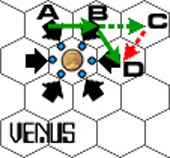
Basically, you preserve whatever motion you had last turn, and you can add on one space of acceleration in any direction to change that vector. Suppose you're going left at two hexes a turn. If you want to speed up you can accelerate in the direction you're moving and next turn you'll be coasting along at three hexes a turn. Or if you want to stop you can accelerate directly opposite the direction you're moving and you'll be going one hex a turn next turn, and can stop further from there. Or if you want to curve, well, you can modify your movement vector that way.

The real fascinating bit, and the part that got me to shell out for my own copy of the game, is how the game handles orbits: as a natural consequence of the simple rules the game allows you to park your ships spinning around a planet with no expenditure of fuel. Exactly like real life. If you want the details, I highly suggest you click over to Project Rho and read about it yourself--I'm not going to recap it here.

The only trouble is that you're stuck with a fixed number of gravity hexes. Imagine you wanted to draw a gravity arrow mid hex C. It'd point directly at the planet, but unfortunately not directly at another hex. You'd screw up your movement going through there as you wouldn't land in the middle of another hex. So if I want to make other, interesting battlefields I can't use the system as is. Especially since I want ships to accelerate at different speeds. You can't move in fractional hexes, so you'd have to have your faster ships move more hexes, which diminishes the value of a block of six gravity hexes; it's too easy to go around.

If I was laying the battle out on a physical board then I doubt I could come up with a better system than Triplanetary runs. On the other hand, why am I constraining myself to a physical board? I'm not going to make it into a video game, but there are advantages to going part way. Let's say we keep time discrete, measured in units of turns, but make space continuous. (As a side note, most video games don't even go there. They make time and space both discrete, or both continuous). What does that do for us?

To start with, it neatly solves the problem of fractional hexes, by allowing fractional hexes. This in turn allows much more flexibility in constructing gravity fields for the ships to fight in. Imagine, for example, a large and long rectangle, with Mars forming the lower right corner. The closer your spaceships get to Mars, the larger effect gravity has on their movements. On the other side of the board though, there isn't much effect at all. But since we're letting the computer worry about it we can still factor it into the result. It also allows fractional movement. Different ships can have different accelerations and still be neatly included on the board without having to worry about it.

The computer also allows us to dynamically track distances and odds. If I'm accelerating this way and I'm at that speed already, how likely am I to hit that guy doing similar things in other directions? If I were figuring this in Gary Gygax's basement forty years ago (has it really been that long?) I'd have to include formula and tables and whatnot, but again, we can let the computer worry about all that. We can even, at little extra cost of expenditure, figure out things like glancing blows (if a nuke detonates at this radius from a ship, how much energy is imparted to their shield?) and the effects of exploding ships on others in their radius. Wonderful stuff, really. I don't have the calculations mapped out yet, but I don't forsee them being too terrible. Or the programming, but that's another issue.

Wednesday, October 13, 2010

The Great Designer Search II: Search and Destroy

Hey everybody! Excitement! Over at Magicthegathering.com they're running a contest to determine who's going to be the next design intern! All kinds of fun, and I'm definitely going to participate. Don't get me wrong, I love designing games on my own but a chance to get paid to do it? These blog posts aren't making me the sweet sweet monies yet. So onward! Full steam ahead! Let's rock this like a series of mid level venues... wait, what's that?

The deadline for submission was on Monday, not Wednesday like I had assumed? Well, crap.

Crap crap crap crap crap crap crap crap crap. Crap!

Err... ahh.... Good news! We get to play along here. It'll be like I'm doing all the work without actually getting a job at the end of it. Whoo!

Crap crap crap.

Let's take a look at those original essay questions and my answers which I was planning on writing up on Tuesday. As I'm not entered into the contest, I'm not confining myself to the 350 word limit per question.

1) Introduce yourself and explain why you are a good fit for this internship.

Pass. Read the freaking first post if you want to know about me.

2) You are instructed to move an ability from one color to another. This ability must be something used in every set (i.e. discard, direct damage, card drawing etc.). You may not choose an ability that has already been color shifted by R&D. What ability do you shift and to what color do you shift it? Explain why you would make that shift.

I'd move flash from blue to green. "Flash" is the ability that allows you to play spells at instant speed, especially creatures. It does powerful things for blue where it is right now, largely because it allows the blue mage the ability to play his deck even moreso in response to whatever his opponent can do. Forget about stalking stones as a win condition, you can hold up your mana and counter whatever he's doing, or if he doesn't do anything you can drop in your threat at the last second and untap with basically haste and your mana up. If the blue mage can counter spells, draw cards and lay threats at instant speed when everybody else uses sorceries then they've got an advantage.

And then there's green. Most of the things green does in constructed are painfully obvious. They lay some undercosted two drop and swing in with him. They get wrathed and lay some more creatures. And then they overrun and kill you. Or they don't. The closest thing they get to clever are giant growth effects, which work like bad removal or bad burn spells. They do see play from time to time in constructed, but not that often these days.

Mono green decks aren't very popular on the tournament scene. Playing one entails beating your opponent into submission, with very little room for subtlety. If we took flash from blue (which would still have counterspells and card drawing at instant speed), we could give it to green, which allows them a chance to set up more clever interactions, especially if the flash creatures get enters the battlefield triggers. Briarhorn is my all star example here. While it can be played like any other pump spell for it's evoke cost, if you play it for it's regular cost it becomes a natural two for one (eating an attacking creature and leaving a 3/3 for you). This helps the green mage grind out card advantage, and gain position by being more clever than his opponents. If you allow green mages to be more clever, you'll get more tournament players playing primarily green decks.

3) What block do you feel did the best job of integrating design with creative? What is one more thing that could have been done to make it even better?

My initial impulse was to go with Shadowmoor, because the whole "world of light plunged into darkness" thing is pretty cool, and you get to do the whole death and decay thing with wither. Persist works pretty well too; Murderous Redcap is so evil that you have to kill him more than once, in good horror story tradition. On the other hand, the best justification I can get for the untap symbol is the whole mirror universe thing, and hybrid mana and retrace don't really fit in that well.

As my brother points out, on the other hand, Shards of Alara does really well. Five different mini worlds each with their own mechanics. Let's go around the circle, shall we?
Bant: Exalted fits in very well with the whole idea of armies settling their difference in duels between champions, which in turn makes very much flavor sense in a world where chaos and death magic (red and black) are absent.
Esper: Everything's robots! While the whole "be an artifact" mechanical connection isn't very deep, I love the whole "remake the world with permanent metal" bit, especially since, absent red and green magic, there's very little that can destroy artifacts. The occasional Dispeller's capsule can, but the present black magic has a harder time.
Grixis. You take a world of darkness, with no light or life magic, and what do you get? Ever growing armies of the undead. Necromancers and demons fighting it out to get at the ever dwindling supply of life to feed off of. The best part is the noble king who wised to the situation first and slaughtered his entire family to become a lich. Sedris, the traitor king. Mechanically, this is represented by Unearth, which means that pretty much anything that Grixis used comes back for one last huzzah as a zombie. Awesome.
Jund. Jund is a world without any forces of order to slow down the chaos. Dragons eat the ogre, who eat the viashino, who eat the goblins. Or something like that. Jund is all about devouring your neighbor before your neighbor devours you. Which makes Devour, a mechanic that literally does that, pretty darn cool.
Naya: Naya's main theme is behemoths, huge freaking creatures. Naya is in Green, White and Red, which allows it to make huge creatures, and it excludes blue or black magic, which have the easy ways of dealing with them. Also works really well.

Granted that some of the things from later sets didn't fit in very well (Domain is fun, yeah, but sort of out of place, for example), Shards of Alara as a block did better at this than the others.

4) R&D has recently been looking at rules in the game that aren't pulling their weight. If you had to remove an existing rule from the game for not being worth its inclusion, what would it be?

The untap step. Why should we untap our permanents when we can just play more? Seriously though, you could make "untap all your permanents" a game action that happens at the beginning of your upkeep and you could skip an entire step. Moreso, skip a unique step where nobody gets a chance to do anything. Drawing your card already works that way, so there's precedent.

5) Name a card currently in Standard that, from a design standpoint, should not have been printed. What is the card and why shouldn't we have printed it?

My first impulse is Jace, the Mind Sculptor. Never mind the price tag, Jace has the problem of being too good. When a particular card is good enough that any deck running that color has to ask itself "why am I not running a full set of this?", then maybe you should wonder if it's too powerful. Jace fits the bill, and it isn't even a role filler like Lightning Bolt or Memory Leak. It adds card advantage and board control and hey, maybe even a win condition to your deck.

The other thing is, brainstorm, while a very fun ability to a large number of players, probably shouldn't have been reprinted next to the fetchlands. It's already a significant amount of card advantage, it'd lead to a lot less fiddling and shuffling if your blue mage had to work a bit to get his shuffle effects. As it is, it produces an effect like Sensei's divining top, if a little less pronounced.

Also, Jace was printed to make blue a little stronger than it had been. Blue was feeling the hurt between the rotation of cryptic command and the printing of Jace. Given that it's been dominant for the entire rest of the freaking game, you'd think they could have waited a little longer.

That's one option. My friend Stephen suggests Emrakul, the Aeons Torn. Emrakul, by being the biggest, baddest creature they've printed yet becomes the goto character for pretty much any combo deck. In vintage, for example, you can tinker out Darksteel Colossus or Inkwell Leviathan depending on what you expect to face. It's a legitimate choice. If they hadn't printed Emrakul, you could still argue choices between Progenitus or Kozilek or Ulamog or even something else, like Magister Sphinx. But when you're getting a free creature, Emrakul is just better than the competition, which makes for less interesting deckbuilding decisions.

The other thing is the "shuffle your graveyard into your library" thing is a cool idea, but it really screws over anybody trying to make a milling deck. And there's always somebody.

That, and when Emrakul hits the ground it's about as close to game over as anything in Magic is. Without the extra turn or the annihilator 6 it might reasonable to deal with. Without the extra turn you get sorcery speed options to deal with it (Journey to Nowhere, Aether Adept, Day of Judgment), with the turn you'd better have something on the board, or you're pretty much dead. (Not complaining about his protection ability, that's pretty cool.) Alternately, with a lower Annihilator value he would only kill a couple permanents of yours, you wouldn't sacrifice half your mana base just to stay alive. And that runs head first into the lesson of Zuran Orb; anything that makes you sacrifice your lands to survive just prolongs your inevitable demise.

6) What do you think design can do to best make the game accessible to newer players?

Now that's a tough one. The main barriers to entry for the game are price and knowledge. You could print sets less frequently, and with more reprints, but that cuts into the more experience players, with respect to point seven. And there are other things that they can't do, because it would hurt sales (make the best manafixing lands uncommon). If I was R&D, I'd try to make each set so it had a strong linear deck available that could be built mostly with commons and uncommons. For example, kithkin from Lorwyn. 4 Wizened Cenn, 4 Knight of Meadowgrain, 4 Goldmeadow Stalwart and 4 Goldmeadow harrier are plenty to produce a solid core for the deck. You can toss in four oblivion rings for creature kill, and whatever appropriate rares you get your hands on. It makes a strong casual deck, and Kithkin decks were tournament viable, if perhaps more expensive because of the Windbrisk Heights and Figures of Destiny.

7) What do you think design can do to best make the game attractive to experienced players?

Pretty much the opposite of last one. Although less focused on price issues, to become an experienced magic player you have to come to terms with that barrier to entry. To keep people playing the game you need to give them new experiences. The good news is that Magic has this built in, what with new cards coming in and sets rotating fairly often. Your more experienced players are less willing to stick with a relatively simple deck, or alternately are more willing to play more difficult decks or explore the murkier areas of deck design. So to keep your more experience players playing R&D needs to design interesting, synergistic cards that don't necessarily confine themselves to one kind of deck.

8) Of all the mechanics currently in Extended, which one is the best designed? Explain why.

Persist. Let me say that again, only with a -1/-1 counter. Persis. For starters, Magic is a game of two for ones. If your card isn't generating some sort of advantage, then why are you playing it? Especially in midrange decks you want your cards to be worth more than one unit of cardboard. Blightning not only makes them discard two cards, but it also damages them for three. Oracle of Mul Daya lets you play another land as soon as it hits play, hopefully off the top of your deck. Aether Adept gives you a 2/2 as well as an unsummon. Two for ones give you naturally powerful cards, which draws the spikes to them, and they make for naturally fun decks. Giving a creature an "enters the battlefield" trigger makes it a natural two for one. If then you allow them to come back and do it again, it's a great feeling. Even if the effect is pretty small, you still feel like you're getting something for free.

Furthermore, it's inherently a creature mechanic. As Mr. Rosewater has said before and as I heartily agree with him, Magic is most fun when it's a battle between creatures. A good, fun creature based mechanic helps promote that.

The "play it exactly twice" mechanic allows you to make reasonably powerful but not overpowered creatures with it. Since it's not infinitely repeatable you get power without having so many worries about balance issues. And it does give your opponents ways to interact with it, via wither effects or graveyard hate or even better two for ones of their own. Alternately, it appeals to the Johnny segment of the playerbase because it allows so many ways to get around playing only twice. Either by infinities (the morningtide lords, the ranger from coldsnap), or bit by bit. (Kitchen Finks next to Oren-Rief, the Vastwood is pretty cool, or Murderous Redcap next to Reveillark)

Lastly, it's a "protect my creature" mechanic, and we all hate losing our creatures. So Timmy who gets his giant Woodfall Primus out can blow something up with confidence that, even if his treefolk burns he'll get to blow something else up.

9) Of all the mechanics currently in Extended, which one is the worst designed? Explain why.

A couple candidates come to mind for this one. Chronologically:

Clash. Clash is an inherently random mechanic, which to some people is very fun but to others not so fun at all. I mean, I get that the difference between clashing and winning and clashing and losing is made not so huge that it won't break me if I keep losing clashes, but by that same token it makes me less excited to win them. The chance of winning a clash is less than 50% on it's own, and the value in manipulating your deck to change that is usually pretty small. Furthermore, Rosewater has asserted that when someone looks at the next card in their deck for the clash it feels like a mini game, where you're excited to see what happens next. Usually it feels to me like a mini game where I'm annoyed that the main game paused.

Next up is Retrace. Retrace allows you to replay a spell by discarding a land and paying the spell's original casting cost. Unfortunately, the spell potentially can be recast many, many times so they can't put anything too powerful on your average retrace spell. (I think we've all learned our lesson from capsize.) The cards are also designed under the assumption that you'll be playing them when you've already got all your mana, so something simple like Monstrify ends up being a giant growth variant for four. Or Oona's Grace- all your lands now have Cycling 2U. Exciting, isn't it? The other problem is, it's not just play this from your graveyard, it's also play it by discarding lands. People like to play out their lands; it's part of what made Zendikar great. Unless you're engaging in Life from the Loam shenanigans (which I wouldn't recommend) retrace is usually a waste of your time.

Lastly, Stephen suggested poison. Now I haven't had much chance to play with Scars yet, so I don't know how this is going to play out by and large. He does make some good points though. Historically poison has been pretty unimpressive; swamp mosquito is the only playable card, and that one not really because there's nothing to play around it. Virulent sliver made for an interesting trick draft deck (And one heck of a pro tour story), but that was it. Now, well, maybe. Part of the problem is that poison is a win condition that you get by attacking people in the combat step. Sound like, oh, regular combat damage to you too? Only it also requires a massive commitment; it does you no good to have them at ten life and five poison counters. And then there's the fact that it breaks EDH. If giving your creatures double strike is good, quadruple strike must be even better (since 1 poison counter =4 life in that format.) And to top it off, if you make the blight dragon your general you can never kill them on general damage; the poison counters will get them first. On the other hand, I'm still not willing to judge it without playing it some more.

All in all though, I'm going with "Retrace" as the worst mechanic in current extended.

10) Choose a plane to revisit other than Dominaria or Mirrodin. What is a mechanical twist we could add if we revisit this plane?

Thematically? I'd love to visit Lorwyn/Shadowmoor again. With the day/night cycle constrained by powerful magic for the past I don't know how long, then there are probably some drastic repercussions for letting that go now. Suppose that the natural order can't reassert itself immediately, that the plane shifts unstably between week long days and nights. These mini auras would reshape the land, occasionally also reshaping the minds of the inhabitants. Natually this would end badly. A curious Lorwyn Boggart stumbles into a Shadowmoor Kithkin Clachan, a Shadowmoor Elf is banned from Lorwyn Elf society because of his scars. That sort of thing. And there would be other effects as well.

Now how we express that mechanically is another matter. Since we're essentially fusing two blocks, it's going to be combining elements from the two, and naturally adding a twist of our own. Of the two major elements, I think color matters will do better for a repeat than tribe matters. And I'll continue to think that until Wizards stops downplaying Zombies as a tribe. As the tribes are spread over three colors between the two blocks, this also allows for more options, especially with hybrid mana. You can run your R/G hybrid goblins alongside your B/R hybrid goblins, but you might want to splash black anyways for a straight black goblin, or the other way around. Additionally, since R&D have been looking to repeat old and good mechanics, it'll be easy to rip one off of either block. You might have noticed me being a fan of persist a bit earlier, but there are other good options.

But I need to describe some mechanical themes of my own. Howabout transformation? You've already got changelings and mimics which play into the theme, other things can be made. Blue's cloning abilities could be hyped up. You could even go so far as to make new flip cards, like from Kamigawa, but that would probably be pushing it.

Specifically, Blue/Black could have a mind wiping theme; imagine rogue auroramancers who have learned to manipulate those magical energies to reshape the minds of others. Although maybe that should be shifted to Red/Black. Blue already gets the clone portion of the mechanics. And red presents a fun twist on it: mages who are using the aurora but have no idea of the results they'll achieve. Blue can come in as the occasional mind control. Black gets it's usual discard effects and so forth reconcepted as using the aurora to rip minds, red gets threaten effects and anything else that fits the bill. I keep imagining a goblin somewhere repeatedly mindwiping himself and never noticing.

As for green, Green gets off too lightly in the villain department. What if Green's main motivation (and the elves in general) is to force the tumultuous terrain into a new natural order? Only green is deciding what is natural, and it's perfectly fine with completely wrecking other people's stuff as long as it's getting closer to it's ultimate vision of nature. SO green gets effects like Muonvuli Acid moss, destroying opposing permanents and replacing them with forests, or at least basic lands. Unfortunately you can't push green into creature kill without seriously distorting the color pie, so it'll have to get it from white. Because it's only been a week since Path to Exile rotated and already I want it back.

Can you tell I didn't really have much of an idea how to answer that last question? I certainly went on and on about it. And yeah, if I wanted to turn this stuff in I'd have to confine myself to the 350 word limit per question. That would have been hard. In any case, I'll be continuing this as the great designer search goes.

The Briefcase of Wonders

I am the sort of man who walks around with a briefcase. I also wax my mustache and wear a fedora, but that's the subject for another time. While there are many and varied uses for a briefcase, the one I'm going through right now it it's ability to work as a mobile repository of games. I've been making an effort to carry as many games as I possibly can around in that thing, so as to be prepared for whatever the situation might dictate. Let's take a look, shall we?


That's the briefcase in it's packed form. In the bottom is a visible bit of wood, that's a cribbage board. Directly up from it are two decks of standard playing cards. Above those decks are two blue deck boxes which contain a prototype for the Presidential Rumble, one of the Awesome Games we're designing. Then are the two be-artted mid sized boxes. They originally came from Magic the Gathering fat packs, for Shadowmoor and Eventide. Now I'm using them as conveniently sized discrete storing units. The one contains a set of dime store poker chips and a complete chess set, the other contains a couple Magic decks.

"Which magic decks" is an interesting question. Assuming I'm going to be using this briefcase amongst an unknown audience I don't want to bring too many. I can (and have) filled the entire space with decks of various kinds before. The main thing though, consonant with the purposes of the briefcase at large, is to provide myself options for any sort of pick up magic game I might run into. Currently the box contains an Elder Dragon Highlander deck (Sedris, the Traitor king as general), my standard Goblins deck, my extended five color reveillark deck, and two simple starter decks, which are designed as a way to teach the game to anyone willing to learn. Naturally, that's not nearly enough. I'd like also to bring along a low power silly casual deck (for environments where tournament decks are less welcome) and at least a draft set of sealed packs.\

Moving on, to the right you see another blue Dragon Shield deck box. They make good good card sleeves. We use them all the time for proxying up cards for our games. If you take the sleeves, put a bulk common magic card in them, you can slip a piece of paper in front of said card and make a game card, which can be shuffled over and over again without suffering wear and tear. In this case though, I believe that box in particular holds a magic deck, Zombies.

The large brown box also holds a number of magic decks, but this one is mostly a place holder. I'm looking to fill that space with more diverse games, although I'm not sure what goes in there. More on that later. Hard to see in the picture, but underneath that box you'll find a notebook where I keep permanent notes, a notepad where I dash off scores for games, and a chess/checkers board.

The pouch on the lid of the briefcase contains a wealth of dice; 25 six sided dice, four twenty sided dice (two of which are the spindowns from those fat packs) various D4s, D8s, and D10s, but oddly enough no D12s. There are a couple pens, and a couple documents stashed there, some boards from various games we're making and the occasional rules printout.

Again with the picture, only all laid out:

Please ignore the changing levels of light. I certainly didn't go back to playing video games in the meantime.

So here comes my next question: what else do I try to fit into my briefcase? I already pointed out the brown box can probably go, seeing as I only really need so many magic decks (All of them!). The problem is I've got to fit it that same size space. I've been considering fitting a RISK set in there too, since the cards and the armies wouldn't take up much space, but I'm not sure I can manage another board; the thing can be tricky to close as it is. On the other hand, there isn't much else I can think of to stick in that last area. Well, there are plenty of things, just they aren't games.

One other thing, I can fit an entire role playing session in there real easy. I've got a couple GURPS books on the thumb drive in my keychain, so all I need are a couple peripherals and a premade, one session adventure. I've been drawing up character sheets, maybe I'll post them one of these days.

Wednesday, October 6, 2010

The Marvelous Suburbs of Space!

You get a wonderful view of the stars in space. When the sun isn't blinding you to anything else, you can see stars by the tens of thousands, with no terrestrial light pollution to drown them out. And without the filtering effect of the atmosphere, you can see them in their true color; blazing reds and blues and greens. Dr. Ames lay contentedly gazing outwards.

"Twinkle twinkle little star
How I wonder what you are"

Idly, Dr. Ames smiled. Without an atmosphere to distort the light, the stars never twinkle. It's one of the disadvantages of being up above the world so high. Abruptly the view went black. There was another one.

The habitat had sensed an incoming burst of cosmic rays, and flashed it's field on. Dr Ames waited a moment to see if it'd be a short one, and regretfully started to climb down his tree. From his days in med school he knew that the risks of damage from cosmic rays were minuscule, but it's hard to convince people of that. Insurance this and precautionary that and you spoil the doctor's evening, but who cares about that?

Carefully, the garden level of the habitat rotates for precisely one gravity, and a fall out of this tree has just as much chance of breaking bones as your standard one on earth's surface. Well, you're less likely to hit a rock, no profit in importing rocks to your artificial garden. You want precisely one G of gravity for your cultivated bit of space; the plants are used to it and it's easier to engineer your habitat than engineer new plants.

Softly he touched down on the cold earth. Quietly he followed the path walking along the rim of the giant wheel. Expertly he put in his spacesuit, and cycled the airlock. He clicked his carabiner onto the nearby line and jumped. As his foot left the airlock, the field switched off and he could see the stars again. "Murphy is playing games with me tonight" he thought as he drifted down the line. "Ah well, I need some sleep anyway." He clicked off the line and onto another one, this one going around the wheel. He was circling through a residential district, the modular cabins stuck together with flexible tubes and connectors swaying gently in the wind.

Wind? Where did they get wind in space? Hard to figure. As near as Dr. Ames could guess, someone had dropped a couch or something, setting off a shock that was only partially absorbed by the tethers, setting off a wave of vibration throughout the district. As he went around, he watched it, and presently the swaying subsided, a casualty of friction in those tethers.

A short jump later and he was in his own airlock, cycling into his own domicile. Naturally, just as the light flashed green he got the call.

"Dr. Ames, you're needed in surgery. Dr. Ames, please report to surgery in LG." Grimly, he punched the airlock cycle button again. "Reporting." Sleep will have to wait. Murphy and his law are on the prowl tonight.

Back on the spoke line again, he jumped, harder now. Past the domiciles, into the industry section of the habitat. He pulls himself, hand over hand, increasing his speed. The quicker he gets to the low gravity operating room the better his patient's chances of survival. Just as his speed seems too much, that a second medical emergency seems the order of the night, he starts to drag his carabiner along the line, slowing him down. He lands hard, but upright. Into the hub.

The hub is relatively small in the center of the spinning habitat, and it opens onto the zero gravity sections. It's where they manufacture the batteries, and the other technological wonders of space, the stuff that makes these whole cities in the sky economically viable. It's also where the clinic is located. There are advantages to operating in zero g.

The hub proper is mostly an open area. Sure, it's got very low gravity, but it's also got things like the Coriolis effect to mess you up. Two doors open out of the hub, leading to the true zero g environments perpendicular to the wheel. They're as large as you please; plenty of room in space. Dr. Ames picked the leftward one, and went through it. The axle remains put with respect to the wheel, only to Dr. Ames it looked to him as if the axle was spinning and he was rightways. He goes in, rights himself, and looks back to where the hub is now definitely the one doing the spinning. The change in perspective always bothered him.

Shaking it off, he quickly made his way to surgery. As he scrubbed in he got the details. Old Mr. Tukerton's new heart gave out. Dr Ames smiled; Murphy again; he had just put that heart in last week. Those new artificials, they haven't gotten the bugs worked out yet.

Heart surgery hadn't changed much. He made an incision about the size of a quarter in the man's chest, and inserted the fiberoptic cable. Carefully he piloted the cable from a monitor towards the soft plastic organ, plugging it into the dataport. The autodiagnostic filled up the monitor.

Dr. Ames stepped back as the medical cryptologist examined the data. Idly, he watched Mr. Tukerton's blood ooze out of the incision, ball up and float off, to be dexterously sucked into a tube by the nurse. Blood is valuable.

"Well, it isn't good." The technician reported. "His heart was stopped completely, so I set it on manual. Other than that, I can tell you that the software's crashed something fierce. I reset it, deleted the cache files, reset it again, fiddled some more with it, and none of it is working."

You can never trust the first run of a product, thought Dr. Ames. Nothing like months of use by the general public to expose the bugs. Still, none of that changes the fact of a man lying there on the table. "Check with the manufacturer, see if they've got a software update."

"Sent in a query already. Let me see... Yup, known issue. Memory leak in the alpha models. Downloading update... Ok, that should be it."

Dr. Ames looked at the monitor, watching the heart activity return to normal. He sewed up Mr. Tuckerton, and gave his prescription.

"Ok, you should be good to go now. We're going to keep you under observation for a hour or so, until we're sure it isn't a recurring issue. You're going to have to take a couple days of home rest. Make sure you're emergency circuit is on and monitoring your heart. That said, you should be back to work by the end of the week. Any questions?"

There never are.

I got hung up at the end of that story, trying to make an interesting medical drama plot. Something about the heart exploding pacemakers. I then realized that I had very little knowledge of or interest in that sort of procedure, so I cut out the drama in favor of the ending you now have. Exciting, isn't it? Mostly I was going for description anyway.

This is how a space habitat works. Mostly it's the great big suburb in the sky. The company (or whoever is financing it) provides a wheel of gardens on the outside and the industry in the middle. Residents provide their own domicile. Rather than a large, rigid space station the housing comes in the form of modular units, with their own machinery, including standardized hookups into the station. Naturally, this is wasteful of material, but it provides several important benefits. Splitting the station into individual compartments lowers the risk from random meteor strieks; if one house is punctured, none of the others will lose pressure. If something larger and slower hits (like a drunken pilot), the flexible connections allows the station to absorb and distribute the blow, minimizing damage. And vacuum separating compartments does wonders to cancel the noise that would otherwise be ubiquitous.

More importantly, though, are the intangible benefits. First of all, it's a privately owned home. It's not a rented apartment, or a bunk in a barracks. It allows the spaceman time away from his fellows, space and security. It is, in a very important sense, his castle. Secondly, it guarantees his freedom. The whole space station setup is reminiscent of West Viginian coal towns, with a company industry, company store and so forth, with one major distinction. It's not a company house, you can get out whenever you want to by simply disconnecting and flying off on your own power.

These houses (and indeed most of the station) are constructed out of plastics and computer chips. Poetically speaking. Hydrogen, Carbon and Silicon are the most abundant elements already outside of Earth's gravity well, so it's orders of magnitude cheaper to use them than, say, steel. Plastics are mostly hydrocarbon chains, and while orbiting hydrocarbons are rare we can make them from water and space dust in a modified synthetic photosynthesis reaction. Most space debris is silicon, so naturally man has discovered numerous ingenious ways to make essential components out of it. Despite the thinness of the material the inhabitants don't suffer much from cosmic rays. Or perhaps because of it; a cosmic ray is likely to blow right past both walls and your body without stopping of affecting much of anything. Now if you encased yourself in a turtle's shell of steel it might get stopped in the steel, producing a barrage of X-rays to bounce around inside. Not healthy.

The habitats run on power beamed from Solar Station Alpha, and are protected by their own, weak Langston field. It's enough to stop the occasional cosmic ray burst, or solar flare activity, or flying debris. It's not going to be particularly effective against concentrated attack...

Thursday, September 23, 2010

When 2+2 doesn't equal 4

A friend of mine recently told me that I post too much math to this blog. Well, today I get to disappoint him. Don't worry, the math isn't hard at all.

We're going to be discussing the cases where 2+2 doesn't necessarily equal four.

Now, before you ask, I'm firmly seated on my rocker, in possession of a full set of marbles and deck of cards, and my lid remains unflipped. Let me get an example for you, so you may be as persuaded of these facts as I am. Well, I shouldn't expect that sort of miracle.

In Magic: the Gathering you win by reducing your opponent's lifetotal from 20 to 0. (A quick side note for the quibblers. Yes, there are alternate win conditions. Yes, there will be exceptions to other things I say about the game. Ignoring the complications for now to keep it simple.) You reduce their life total by attacking them with creatures. So it'd take twenty turns to kill someone with a one power creature, and ten with a two power creature, assuming they don't do anything that stops you. In fact, let me make a table of that for you:

1 power: 20 turns
2 power: 10 turns
3 power: 7 turns
4 power: 5 turns
5 power: 4 turns
6 power: 4 turns
7 power: 3 turns
8 power: 3 turns
9 power: 3 turns

Contrary to my previous assertion, we see that it takes exactly two bears to win the game in the same time as one Serra Angel. But look at three power, if you work out the ratio it takes 40% more hill giants to kill in the same time span a Serra Angel could, when 4 is only 25% larger than three. How does that work? Even worse, take a look at the six power guys. Despite being slightly better than a five power guy, they still kill your opponent in the same amount of time. Same thing with seven, eight and nine power, it's all three turns.

This works, not because in some situations three is actually smaller than others, but because three doesn't divide evenly into 20. You only need to deal 20 damage, there's no bonus for going over. Since doing three damage a shot doesn't stop until you hit 21, that last point of damage is wasted. Attacking for five gets to twenty exactly in four turns, but attacking for six gets to twenty four, with surplus pain. Relatively speaking, five is just as good as six despite the fact that our starting postulates make six objectively better.

(The example is pretty obviously not that relevant in a game, but I have noticed that sort of thing come up playing an aggro deck against control. Looking at a 6/6, counting the turns I had to draw a lightning bolt to finish him off and realizing that it was still four.)

So where else does this apply? Well, I can't think of another game off hand, but it is the mechanism that allows computer worms to work. Y'know, like the one in Office Space? Or that old Superman movie they referenced in Office Space? Anyway, the programs treat dollars as if they're continuous, which means that when they divide them they sometimes get fractional pennies that can't be expressed in real world money. So they round them off, because who cares about a fraction of a penny anyway? All it took from there was someone to notice that money was disappearing and figure out a way to make that money his.

Another way this sort of thing happens is when you're talking about relative power levels. Again with the magic example. Let's say that on my side of the board I've got three glory seekers (a 2/2 with no abilities.) On your side of the board you've got one Stone Golem (a 4/4). If I try to attack with my glory seekers, one is going to get beaten by the angel and then I'll have traded a creature for a lousy couple damage-- not a very good exchange. So I've got to sit back and wait until you decide to do something, which means that your one 4 power guy is superior to my three two power guys, despite the math saying something different. (Of course, all this can be changed by either of us having any one of a number of combat tricks, but we're doing the default right now.)

More generally, we can look at a set and try to figure out what the relevant toughness is. Take Magic 2011, the most recent core set. My brother did the analysis, by the time he was drafting his first packs he already knew to stay away from two toughness cards like glory seeker. Why? There's an abundance of creatures that can profitably hold off an army of glory seekers in the set. Like that Stone Golem. Or a Giant Spider. Or an Azure Drake. Or any number of commons. That and Pyroclasm, as a kill spell that hits multiple creatures of two toughness, could really wreck his day. A single 3/3, by virtue of that one more point of power, can fight it's way through quite a few more combat situations than a 2/2. Leading me to make such inane but accurate statements like "Three is SO much more than two!"

Ok, another example. Let's talk hearts. (If you don't know hearts, your windows computer has it as one of it's built in games. Learn how, it's a good game.) Ok, say that I'm playing in a four player game, and it's my lead. Hearts has just been broken, and I want to get rid of the lead, so I want to lead a low heart. I have the 5 and the 9. How likely am I to take the trick if I lead one versus the other?

Let's say that I lead with the five. There are exactly three cards that get under it (the 2, 3 and 4). If I lead the Nine, there are three more cards (6, 7 and 8; we know where the five is already.) The problem is is that taking it with the nine isn't twice as likely, it's several times as likely. I'd give you the actual numbers but I royally confused myself trying to remember how to do a simple calculation and so you're going to have to suffer through inexact figures.

But think of it this way. I lead the five, West has to have one of the three, North has to have one of the two remaining and East has to have the last one. It's not that likely. If I lead with the nine, even if the other two have cards East has any of four possibilities to duck under. Or each of them might have two. The only way the nine doesn't take it is if some sad sack has missed six chances to get one of those cards in his quarter of the deck. Those aren't very good odds. In this way we see that the Nine is more than twice as dangerous as the five, even against the logic of our first intuition.